
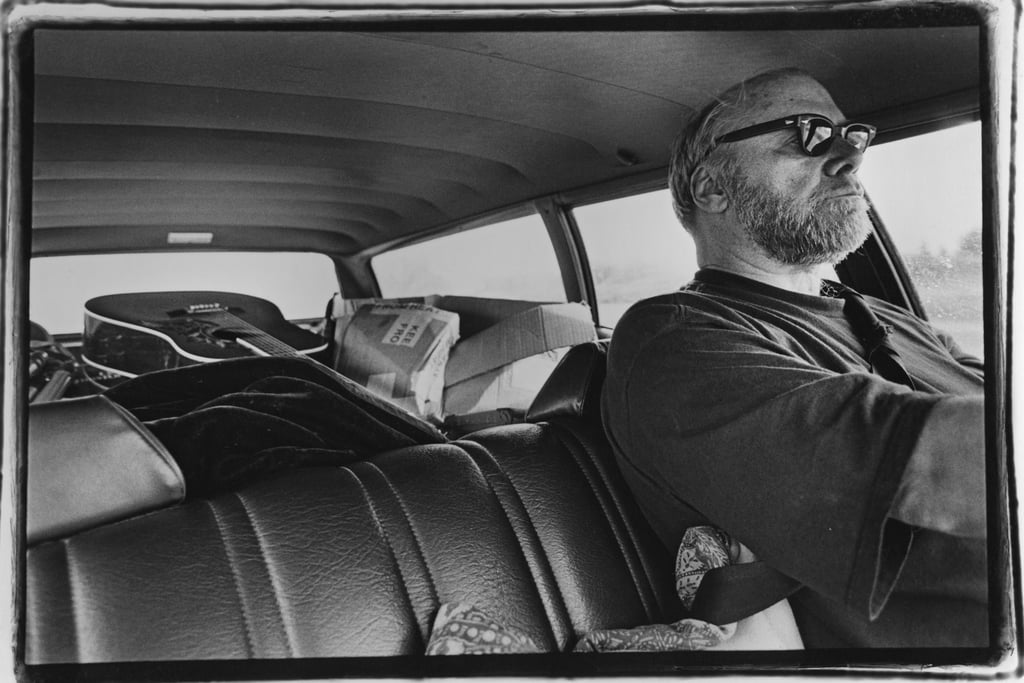
Photo Courtesy of Bettina Herzner
Artist Profile: American Fingerstyle Guitarist John Fahey
ARTICLE
Sam McGriskin
4/1/20266 min read

Originally published in Vol. 2 No. 1
________________________
John Fahey was an American fingerstyle guitarist born in Washington, D.C. on February 28, 1939. His unique style earned him the 35th spot on Rolling Stone’s top 250 guitarists of all time, and though he found success, his highs were high, and his lows were low. By the 90s, Fahey was pawning guitars and records to pay the rent.
Fahey’s combination of country and blues fingerstyle guitar with classical-style structures created a new sound that Fahey described as “American primitive guitar.” This became Fahey’s genre as he didn’t fit well into other categories. As a guitarist, he emphasized rhythm which he attributed to rural southern black blues players whom he listened to on old 78s from the late 1920s and early 1930s.
Fahey was an artist in several senses and seriously delved into writing and painting. His album liner notes were long and he very much enjoyed writing them. Often touting the legend of himself or his alter-egos, the notes contain tall tales and short stories that regularly become nonsensical. The opening line to one story on Fahey’s first record, Blind Joe Death reads “Many years ago in the orient while John Fahey was learning the ancient martial art of Samurai sword fighting…”
Painting became a pastime for Fahey later in his life and led to a series of abstract pieces which were exhibited in The East Village, in New York in 2010.
Fahey’s parents were both pianists, and his mother would often bring him to country and bluegrass shows in his youth. At thirteen, Fahey bought a $17 Silvertone guitar from Sears & Roebuck with money he saved from his paper route. He learned to play with some older guitarist friends in Takoma Park and bought a chord book to study. “Blue Yodel No. 7” by Jimmie Rodgers left a big impact on Fahey who was later drawn into the blues after hearing “Praise God I’m Satisfied” by Blind Willie Johnson. He has referred to his first time hearing this song as a religious experience:
“I started to feel nauseated so I made him take it off, but it kept going through my head so I had to hear it again,” he said in a 1998 interview with The Wire magazine. “When he played it the second time I started to cry, it was suddenly very beautiful. It was some kind of hysterical conversion experience, where in fact I had liked that kind of music all the time, but didn’t want to. So, I allowed myself to like it.”
Still, Fahey had a passion for classical music which would have a meaningful impact on his playing and composing. As time passed, Fahey developed a unique fingerpicking style inspired by Bluegrass, Blues and 20th-century classical composers like Béla Bartók. He became an avid record collector and would travel from shop to shop and town to town with friend and musicologist Richard K. Spottsword, in search of new music. In 1968, Fahey’s playing was recorded for the first time at Fonotone Records–a label owned by his friend Joe Bussard. He recorded under the name Blind Joe Thomas.
Fahey struggled with stage fright, which he later learned to cope with by getting himself into a light trance; something he was taught to do by a hypnotherapist.
About a year after his first recording, Fahey started his own label called Takoma Records, named after his hometown. He then borrowed money from an Episcopal priest and used his earnings from a job as a gas station attendant to record his first album Blind Joe Death in 1959. One side of the album credited John Fahey and the other credited Blind Joe Death–one of Fahey’s alter egos. Only 100 copies were pressed. Five were broken in transport and the others sold very slowly. Fahey would slip copies onto record store shelves, thrift store bins and sell them at the gas station while he was on the job.
Fahey received a degree in philosophy and religion at American University and went on to study philosophy at Berkeley. There, he was unimpressed with the hippie scene and the Pete Seeger-inspired folk players. Fahey was often compared to Pete Seeger, and he did not take this as a compliment.
Fahey was invited to join UCLA’s folklore master’s program and completed an M.A. in 1966. He completed his master’s thesis on Charley Patton, with help from his friend, Alan Wilson of Canned Heat.
While living in Berkeley, Fahey continued to focus on Takoma Records and sent a postcard to Aberdeen, Mississippi in an effort to track down Delta blues guitarist Bukka White. By chance, White’s cousin worked for the postal service and forwarded the letter to White, who agreed to record with Takoma. Mississippi Blues was released and was followed by Fahey’s second album Death Chants, Breakdowns & Military Waltzes, in 1963. To Fahey’s surprise, his album sold better than White’s.
Throughout the ‘60s, Fahey continued to release albums under Takoma Records and Vanguard Records. He also worked on recordings with the psychedelic rock group, The Red Crayola. In 1969 (some sources say ‘67), he married his first wife Janet (Jan) Lebow who also played guitar and supported Fahey’s ambitions. Around this time, Fahey began recording Canned Heat and Leo Kottke under his label. Kottke’s album 6- and 12-string Guitar sold over 500,000 copies.
At this point, Fahey had gained a sizable following, was married, had a home and had made decent money with his record label. The ‘70s though, would mark the beginning of a long line of troubles for the musician. Fahey and Jan divorced in ‘73 and he lost the house. He began drinking heavily, got married again, divorced again, sold Takoma records in 1979 and married his third wife Melody in ‘81.
In the early ‘80s, Fahey met producer Terry Robb, and the two worked on recordings for Verrick, a subsidiary of Rounder Records. He then contracted Epstein-Barr syndrome in 1986. Fahey divorced Melody in the late ‘80s and his downhill trajectory grew steeper yet. He lived in poverty in the early ‘90s, staying at several cheap motels, selling records and pawning guitars to make rent. Friends of Fahey have noted that the musician has always struggled to take care of himself, which was amplified by an abundance of health issues, including diabetes and insomnia which he took pills for.
In 1994, Fahey released a compilation album called Return of the Repressed. This album, coupled with a popular article on Fahey by Byron Coley for Spin Magazine (a good read) spurred a revival for Fahey’s career. When his father died in 1995, Fahey used his inheritance to start Revenant Records with Dean Blackwood. He used this label to revive old-timey, obscure music, which Fahey knew much of from his record collecting. The label found success and the 2001 release of Screamin’ and Hollerin’ the Blues: The Worlds of Charley Patton, which went on to win three Grammy Awards.
On February 22, 2001, six days before his 62nd birthday, Fahey died in Salem hospital due to complications with a sextuple coronary bypass. He is buried at Restlawn Memory Gardens in West Salem, Oregon.
“I’ve always really thought of myself as a spiritual detective and a psychological detective,” said Fahey to Byron Coley for that Spin Magazine article, “I guess with my music I’m always trying to get to a fuller understanding of myself. I felt so alienated from the culture around me, like I was from a different planet, like I wasn’t really a member of the human race. I had two heads, one just wasn’t visible. So I was looking for another path of music. I didn’t really know what it was. I didn’t care what it was and I still don’t. Makes no difference to me and that’s perfectly okay. ‘Cause I’m just a little blip. The whole style is just a little blip on all the mainstream of music. We don’t fit anywhere. And we never will.”
Over the course of his life, Fahey released approximately 36 studio albums along with several more live and compilation albums. His avant-garde style has influenced many musicians from Leo Kottke to Sonic Youth. Fahey’s health and money issues slowed but could not stop his prolific output and he settled himself into history as one of the world’s greatest guitarists.


RUNNING MAN PRESS
CoNTACT
info@runningmanpress.ca
© 2024. All rights reserved.
ads@runningmanpress.ca