
Artist Profile: Werner Herzog
“Every man should pull a boat over a mountain once in his life.” - Werner Herzog
ARTICLE
Sam McGriskin
7/6/202615 min read
Published in Vol. 2 No. 2
________________________
Following an Allied bombing in Munich Germany, in 1942, Elizabeth Stipetić found her two-week-old son Werner in his cradle, covered in rubble. She immediately moved him and his brother Tilbert, to the remote village of Sachrang in the Upper Bavarian Alps. This is where Herzog would spend his early childhood, close to the Austrian border, without electricity or running water.
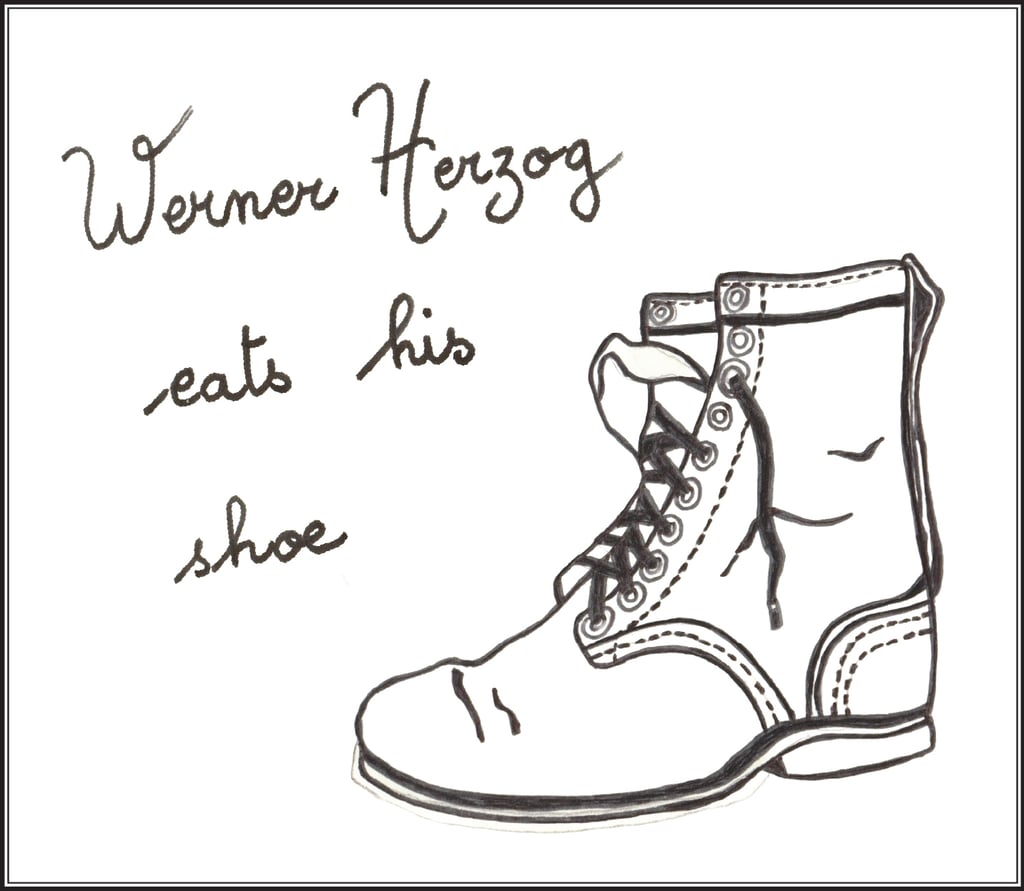
Werner Herzog has eaten his shoe, hypnotised chickens, smuggled weapons across the US/Mexico border, been imprisoned in Africa (while sick from malaria), narrowly avoided the infamous LANSA flight 508, spent two nights stranded on a mountain peak in Patagonia, endured Klaus Kinski and directed close to eighty feature films and documentaries.
Herzog and his brother explored the mountainous landscape around Sachrang, oblivious to their poverty, as it was not unique. They lived on whatever their mother could scrounge—a loaf of bread per week and meals like dandelion leaf salad. His mother, Elizabeth, had studied as a biologist and due to her doctorate, she was sometimes mistaken for a medical doctor. She duly took on this role as there was not much in the way of medical care in the village.
Herzog has described his father, Dietrich, as a “marginal character” who was away for much of his childhood–in part due to the war. Dietrich was self-serving and according to Herzog, “could talk the hind legs off a donkey.” He was unfaithful to Elizabeth and they divorced shortly after he returned from the war. He failed to pay alimony after their divorce, though the boys would live with him for a time in Wüstenrot later on. Apart from recognizing his father’s intellect, Herzog hasn’t given him much praise, even calling him “a father who was not loved” by his wives and children.
His parents were both early members of the Nazi Party, though his mother renounced it early on. They were both put through “de-Nazification” after the war and his father was still bitter about the German defeat.
The brothers had a somewhat sheltered upbringing in Sachrang, which Herzog describes as “archaic.” They slept on uneven burlap sacks filled with dried ferns and their blankets sometimes froze from their breath. When it was too cold to use the outhouse, they used a bucket in the hallway, which would also freeze on occasion. Before attending school, they tended cows which brought them their first pay. The boys also used draft donkeys to lug beer and lemonade up the Geiglstein mountain. This was done barefoot as they only wore shoes during winter. They also had a younger half-brother, Lucki, who would live with them on occasion and with whom they got on very well. Lucki, who goes by his mother’s name (Stipetić) works alongside Herzog to this day.
Herzog witnessed a tremendous change in technology. He saw fields being mown by hand with scythes and heard a town crier deliver news: “Hear ye, hear ye!” It was at age eleven, while attending Sachrang’s one-room schoolhouse, that Herzog saw his first film thanks to a travelling projectionist–he was unaware of the existence of cinema before this. He made his first phone call at age seventeen.
Herzog was an introverted child, though he had a temper that was fully exposed one day during a fight with Tilbert. The brothers often fought violently, but on this occasion, Herzog stabbed his brother in the leg with a knife and also cut his wrist. Blood covered the floor and Elizabeth rushed to Tilbert’s aid. Herzog was shocked by his own behaviour and determined that he needed to make a profound change. He claims to have done this with “rigorous self-discipline,” which he attributes to a good part of his character today.
On their first trip to Munich, Herzog and his brother greeted everyone on the street individually, just as they had been raised to do in Sachrang. This kept them plenty busy as hundreds of Munichers passed by. Their mother was then fully embarrassed when the boys proceeded to pull down their lederhosen and pee on the street. The family later moved back to Munich, when Herzog was twelve, and lived in the same building that he had spent his first weeks in, only this time they were one story below in a pension. The surrounding buildings were still in ruins from the war. This is where Herzog would meet Klaus Kinski–the wild-tempered actor who would play the lead in five of Herzog’s films.
Kinski was taken in off the street by Clara Rieth, the charitable owner of the pension. He occupied a room down the hall from Herzog–rent-free. He much enjoyed the idea of being a starving artist and threw regular fits that disturbed everyone but Herzog, who was fascinated by him. At this time, Herzog would have been thirteen and Kinski about twenty-six. Herzog was not yet thinking of making films. His first impression of Kinski was when one night, he heard chaotic noises coming from his building on his way home from school. When he opened the door, he saw Kinski screaming and being chased around the apartment by a young woman who was hitting him with a wooden tray. Kinski had reached up her skirt.
Herzog refers to Munich’s post-war state as “the best settings to play in.” His friends who spent their childhood there played in the bombed-out buildings and streets where they would find weapons and other treasures left behind during the war.
There in Munich, when Herzog was thirteen or fourteen, he went through a religious period. He joined the Catholic church and was baptized. This came as a surprise to his family, as his parents were both atheists. He turned to religion after feeling an “emptiness,” though he struggled to accept the dogma and hierarchy of the church. He left after about two years but religious language and themes are strewn throughout his projects, often seen in the titles of his films and books.
Herzog did not do well in school, and his brother Tilbert fared even worse. He attended a reputable humanistic high school where he learned Latin and Greek. Of this time, Herzog said, “I had few friends and hated school. There is such a thing as academic intelligence and I didn’t have it.” Tilbert fell two years behind and dropped out at fourteen. He then joined a timber company and quickly climbed the ranks. After that, he cofounded a trading company that became successful and he was able to help support the family.
While Herzog attended high school, he was also working as a welder in a steel factory to support his new aspirations of becoming a filmmaker. He also travelled around Europe and had a brief job at the docks in Manchester when he was eighteen. He attended the University of Munich to study history and literature but this was cut short as he had already begun making films. The first of which was a short film called Harakles (1962), which he shot using a 35mm camera that he stole from Munich Film School. Around this time, Herzog travelled through Africa, where he became severely ill with bilharziosis and he returned to Germany.
In his early twenties, Herzog accepted a scholarship to Duquesne University in Pittsburgh, assuming there would be less “academic nonsense” in the Steel City. He also hoped to take advantage of the film studio and camera equipment but quickly realized it was nothing special. He decided to stay registered mostly in order to keep his visa. At this point, Herzog was moving from couch to couch until one day he hitched a ride with a woman named Evelyn Franklin, who invited him to live with her and her six children. He started working for a producer at WQED who was making documentaries for NASA. Before long, Herzog received a summons from immigration authorities for violating his visa. He then drove in a straight shot to Mexico in an old Volkswagen he had recently purchased.
To get by in Mexico, Herzog first took on a brief bull riding stint in Guanajuato, which was cut short by an injury. He then began smuggling goods across the border for well-to-do rancheros whom he had met at the charreadas. He’d mostly load his VW with TVs, stereos and other electronics, though at times he was carrying Colt revolvers. When this fell through, Herzog travelled to the south of Mexico. He was obsessed with “the vague idea that I would help form an independent Mayan state in Petén.” His plans were derailed when he became sick with Hepatitis. He drove back to the US for treatment and then flew back to Germany.
Herzog completed his first feature film Signs of Life in 1968 at the age of twenty-six. The film follows a German soldier who slowly goes stir crazy during WWII while guarding a munitions depot. It was a critical and commercial success which aided Herzog in securing funding for new projects. Herzog had also completed four short films at this point, including the mysterious Game in the Sand (1964), which was never released because it “got out of hand.” Of the film, all we know is that it is fourteen minutes long and involves four children and a chicken in the sand.
In 1969, Herzog completed a documentary called The Flying Doctors of East Africa. This was the first of many documentary films, which would become the genre that Herzog is most well-known for. In the 70s, he completed fourteen films beginning with Even Dwarfs Started Small. This feature film encompasses much of Herzog’s eccentric style, which he would form and develop much throughout this decade. The “absurdist-comedy” features an all-dwarf cast who are confined to a remote island. It also involves the killing of a pig and the crucifixion of a monkey. Several injuries occurred on set, including to one actor who was run over by an unmanned vehicle and who later caught on fire. Herzog jumped on him to smother the flames and then promised the cast that if there were no more injuries on set, he would jump into a cactus patch–which he did.
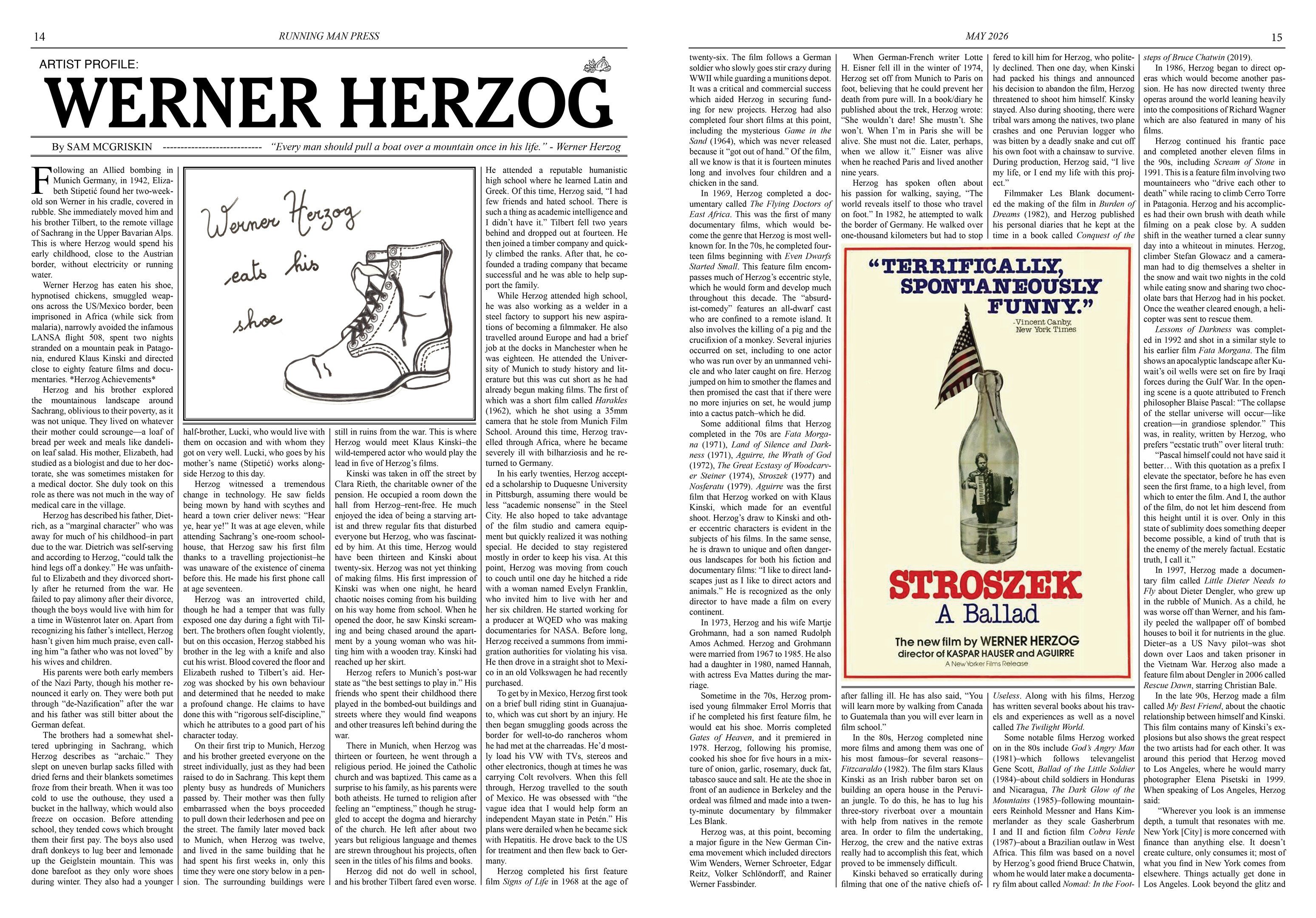
Some additional films that Herzog completed in the 70s are Fata Morgana (1971), Land of Silence and Darkness (1971), Aguirre, the Wrath of God (1972), The Great Ecstasy of Woodcarver Steiner (1974), Stroszek (1977) and Nosferatu (1979). Aguirre was the first film that Herzog worked on with Klaus Kinski, which made for an eventful shoot. Herzog’s draw to Kinski and other eccentric characters is evident in the subjects of his films. In the same sense, he is drawn to unique and often dangerous landscapes for both his fiction and documentary films: “I like to direct landscapes just as I like to direct actors and animals.” He is recognized as the only director to have made a film on every continent.
In 1973, Herzog and his wife Martje Grohmann, had a son named Rudolph Amos Achmed. Herzog and Grohmann were married from 1967 to 1985. He also had a daughter in 1980, named Hannah, with actress Eva Mattes during the marriage.
Sometime in the 70s, Herzog promised young filmmaker Errol Morris that if he completed his first feature film, he would eat his shoe. Morris completed Gates of Heaven, and it premiered in 1978. Herzog, following his promise, cooked his shoe for five hours in a mixture of onion, garlic, rosemary, duck fat, tabasco sauce and salt. He ate the shoe in front of an audience in Berkeley and the ordeal was filmed and made into a twenty-minute documentary by filmmaker Les Blank.
Herzog was, at this point, becoming a major figure in the New German Cinema movement which included directors Wim Wenders, Werner Schroeter, Edgar Reitz, Volker Schlöndorff, and Rainer Werner Fassbinder.
When German-French writer Lotte H. Eisner fell ill in the winter of 1974, Herzog set off from Munich to Paris on foot, believing that he could prevent her death from pure will. In a book/diary he published about the trek, Herzog wrote: “She wouldn’t dare! She mustn’t. She won’t. When I’m in Paris she will be alive. She must not die. Later, perhaps, when we allow it.” Eisner was alive when he reached Paris and lived another nine years.
Herzog has spoken often about his passion for walking, saying, “The world reveals itself to those who travel on foot.” In 1982, he attempted to walk the border of Germany. He walked over one-thousand kilometers but had to stop after falling ill. He has also said, “You will learn more by walking from Canada to Guatemala than you will ever learn in film school.”
In the 80s, Herzog completed nine more films and among them was one of his most famous–for several reasons–Fitzcaraldo (1982). The film stars Klaus Kinski as an Irish rubber baron set on building an opera house in the Peruvian jungle. To do this, he has to lug his three-story riverboat over a mountain with help from natives in the remote area. In order to film the undertaking, Herzog, the crew and the native extras really had to accomplish this feat, which proved to be immensely difficult.
Kinski behaved so erratically during filming that one of the native chiefs offered to kill him for Herzog, who politely declined. Then one day, when Kinski had packed his things and announced his decision to abandon the film, Herzog threatened to shoot him himself. Kinsky stayed. Also during shooting, there were tribal wars among the natives, two plane crashes and one Peruvian logger who was bitten by a deadly snake and cut off his own foot with a chainsaw to survive. During production, Herzog said, “I live my life, or I end my life with this project.”
Filmmaker Les Blank documented the making of the film in Burden of Dreams (1982), and Herzog published his personal diaries that he kept at the time in a book called Conquest of the Useless. Along with his films, Herzog has written several books about his travels and experiences as well as a novel called The Twilight World.
Some notable films Herzog worked on in the 80s include God’s Angry Man (1981)–which follows televangelist Gene Scott, Ballad of the Little Soldier (1984)–about child soldiers in Honduras and Nicaragua, The Dark Glow of the Mountains (1985)–following mountaineers Reinhold Messner and Hans Kimmerlander as they scale Gasherbrum I and II and fiction film Cobra Verde (1987)–about a Brazilian outlaw in West Africa. This film was based on a novel by Herzog’s good friend Bruce Chatwin, whom he would later make a documentary film about called Nomad: In the Footsteps of Bruce Chatwin (2019).
In 1986, Herzog began to direct operas which would become another passion. He has now directed twenty three operas around the world leaning heavily into the compositions of Richard Wagner which are also featured in many of his films.
Herzog continued his frantic pace and completed another eleven films in the 90s, including Scream of Stone in 1991. This is a feature film involving two mountaineers who “drive each other to death” while racing to climb Cerro Torre in Patagonia. Herzog and his accomplices had their own brush with death while filming on a peak close by. A sudden shift in the weather turned a clear sunny day into a whiteout in minutes. Herzog, climber Stefan Glowacz and a cameraman had to dig themselves a shelter in the snow and wait two nights in the cold while eating snow and sharing two chocolate bars that Herzog had in his pocket. Once the weather cleared enough, a helicopter was sent to rescue them.
Lessons of Darkness was completed in 1992 and shot in a similar style to his earlier film Fata Morgana. The film shows an apocalyptic landscape after Kuwait’s oil wells were set on fire by Iraqi forces during the Gulf War. In the opening scene is a quote attributed to French philosopher Blaise Pascal: “The collapse of the stellar universe will occur—like creation—in grandiose splendor.” This was, in reality, written by Herzog, who prefers “ecstatic truth” over literal truth:
“Pascal himself could not have said it better… With this quotation as a prefix I elevate the spectator, before he has even seen the first frame, to a high level, from which to enter the film. And I, the author of the film, do not let him descend from this height until it is over. Only in this state of sublimity does something deeper become possible, a kind of truth that is the enemy of the merely factual. Ecstatic truth, I call it.”
In 1997, Herzog made a documentary film called Little Dieter Needs to Fly about Dieter Dengler, who grew up in the rubble of Munich. As a child, he was worse off than Werner, and his family peeled the wallpaper off of bombed houses to boil it for nutrients in the glue. Dieter–as a US Navy pilot–was shot down over Laos and taken prisoner in the Vietnam War. Herzog also made a feature film about Dengler in 2006 called Rescue Dawn, starring Christian Bale.
In the late 90s, Herzog made a film called My Best Friend, about the chaotic relationship between himself and Kinski. This film contains many of Kinski’s explosions but also shows the great respect the two artists had for each other. It was around this period that Herzog moved to Los Angeles, where he would marry photographer Elena Pisetski in 1999. When speaking of Los Angeles, Herzog said:
“Wherever you look is an immense depth, a tumult that resonates with me. New York [City] is more concerned with finance than anything else. It doesn’t create culture, only consumes it; most of what you find in New York comes from elsewhere. Things actually get done in Los Angeles. Look beyond the glitz and glamour of Hollywood and a wild excitement of intense dreams opens up; it has more horizons than any other place. There is a great deal of industry in the city and a real working class; I also appreciate the vibrant presence of the Mexicans.”
Herzog completed another thirteen films in the 2000s. The first of them was Wings of Hope in 2000, which tells the story of Juliane Koepcke who was the sole survivor of LANSA flight 508 which crashed in the Peruvian jungle after being struck by lightning. Herzog himself was supposed to be on board this flight, and he was waiting in the same airport as Koepke when his reservation was canceled due to a last-minute change in itinerary.
In 2005, Herzog completed one of his most well-known films, Grizzly Man. This documentary follows Timothy Treadwell whose goal was to protect grizzlies from poachers, but he was eventually killed by one while living amongst them. Encounters at the End of the World, a documentary about Antarctica’s scientists, animals and landscapes, came out in 2007 and one scene gained considerable attention when Herzog asks if there is such a thing as insanity among penguins and follows one penguin as it leaves the colony: “And here, he’s [penguin] heading off into the interior of the vast continent. With five thousand kilometers ahead of him, he’s heading towards certain death.”
In 2009, Herzog founded Rogue Film School, which places more focus on action than on theory. Herzog’s description: “The Rogue Film School is not for the faint-hearted; it is for those who have travelled on foot, who have worked as bouncers in sex clubs or as wardens in a lunatic asylum, for those who are willing to learn about lockpicking or forging shooting permits in countries not favoring their projects. In short: for those who have a sense of poetry. For those who are pilgrims. For those who can tell a story to four-year-old children and hold their attention. For those who have a fire burning within. For those who have a dream.”
In 2010, Herzog was the first to arrive at the scene of a car accident. When he knelt to the window of the overturned vehicle, he saw Joaquin Phoenix upside down in his seat. Herzog told him to relax and snatched away his lighter as Phoenix attempted to light a cigarette while gasoline dripped around him. Herzog pulled Phoenix from the car and waited for help to arrive.
That same year, Herzog completed Cave of Forgotten Dreams, the first of another thirteen films in the 2010s. This documentary explores the Chauvet Cave in France, which contains well-preserved wall paintings from roughly thirty thousand years ago. Herzog has been interested in the subject since he walked by the window of a bookstore when he was thirteen. On display was a book with a cave painting of a horse from about seventeen thousand years ago. He calls this the moment of his spiritual awakening. He worked as a ball boy on tennis courts for two months until he had enough money to buy the book.
Also in the 2010s, Herzog made documentaries about fur traders in the Siberian Taiga, death row inmates in the U.S., the vast advances of the internet, volcanoes and their impact on human life, a meeting with Mikal Gorbachev and others. While working on a series of death row documentaries after Into the Abyss (2011) and viewing photos and evidence from the crime scenes, Herzog woke himself and his wife with a scream in the middle of the night and knew it was time to move on to other projects.
In the 2020s, Herzog made Fireball: Visitors from Darker Worlds, one of the three documentaries involving volcanologist Clive Oppenheimer. Herzog’s fascination with volcanoes was again brought to the screen in his eightieth year with The Fire Within (2022). This film was made using 16mm footage shot by French volcanologists Katia and Maurice Kraft and displays otherworldly shots of volcanoes, eruptions, fast-flowing lava streams and the aftermath of some of these events.
More recent films include Theatre of Thought (2022), about the human brain and Ghost Elephants (2025), which is about South African naturalist Steve Boyes and his search for an unknown species of African elephant. Also in 2025, Herzog released a book called The Future of Truth.
In his old age, Herzog hasn’t slowed and is currently working on an animation film called The Twilight World, based on his 2021 novel of the same name which is a fictional account of real-life Japanese soldier Hiroo Onoda, who refused to surrender for nearly 29 years after the end of WWII. He is also set to release a feature film this year called Bucking Fastard, based on real-life identical twin sisters Greta and Freda Chaplin. Herzog tracked them down and interviewed them many years ago and wrote about his intent for the film in his 2022 memoir, Every Man For Himself and God Against All.
Though Herzog is primarily a director, he considers himself a writer and a poet and believes that his writing will outlive his films.
**
“The enormity of their flat brain, the enormity of their stupidity, is just overwhelming. You have to do yourself a favor when you’re out in the countryside and you see a chicken: Try to look a chicken in the eye with great intensity, and the intensity of stupidity that is looking back at you is just amazing. By the way, it’s very easy to hypnotize a chicken; they are very prone to hypnosis, and in one or two films I have actually shown that.” - Werner Herzog




RUNNING MAN PRESS
CoNTACT
info@runningmanpress.ca
© 2024. All rights reserved.
ads@runningmanpress.ca