
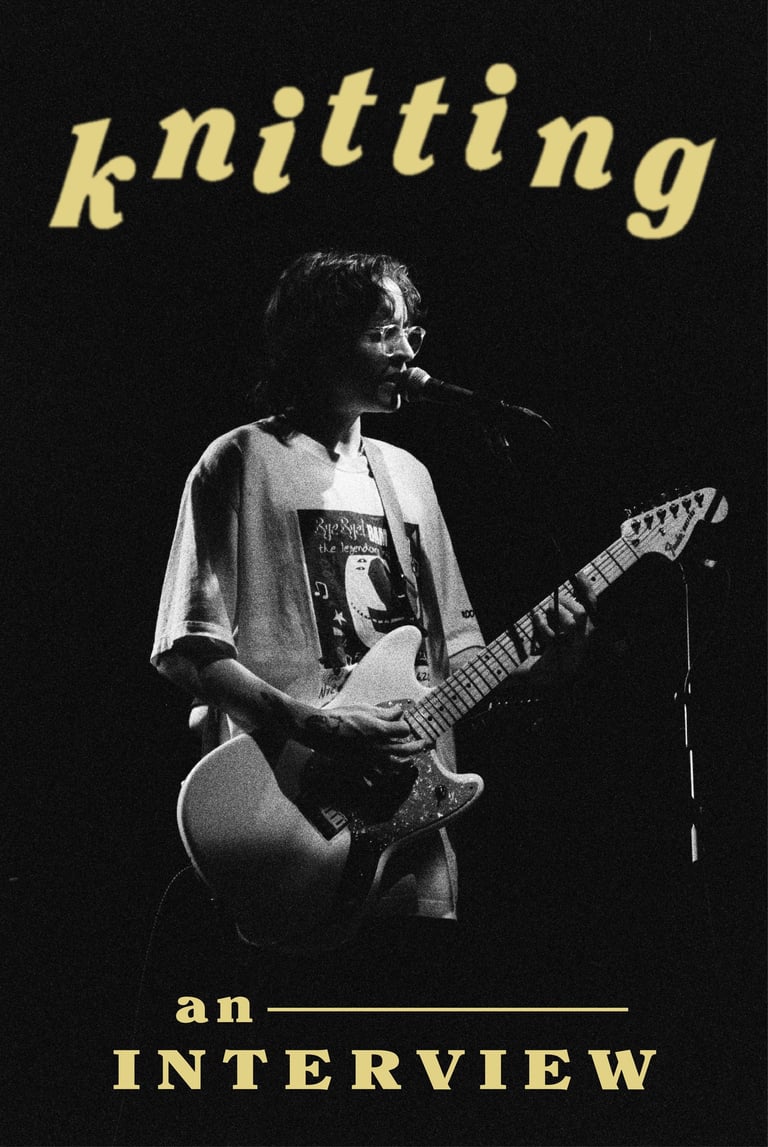
INTERVIEW: knitting on their Leaked Album, their Best Tour Memories and Montreal's Best Poutine
INTERVIEW
Shannon McCann
7/25/202613 min read
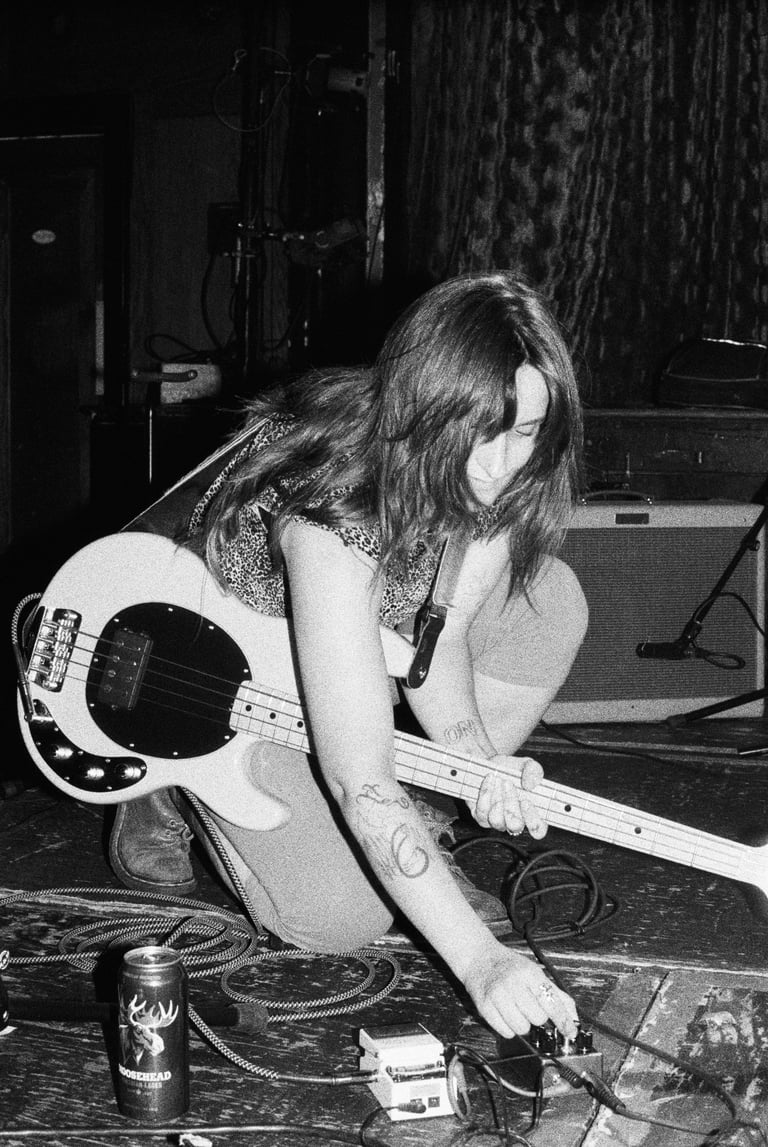
knitting are a band from Montreal made up of members Mischa Dempsey, Sarah Harris and Andy Mulcair. The group has recently released Souvenir (Mint Records) and is now on tour in Canada supporting the album. RMP caught up with the band before their show in Montreal.
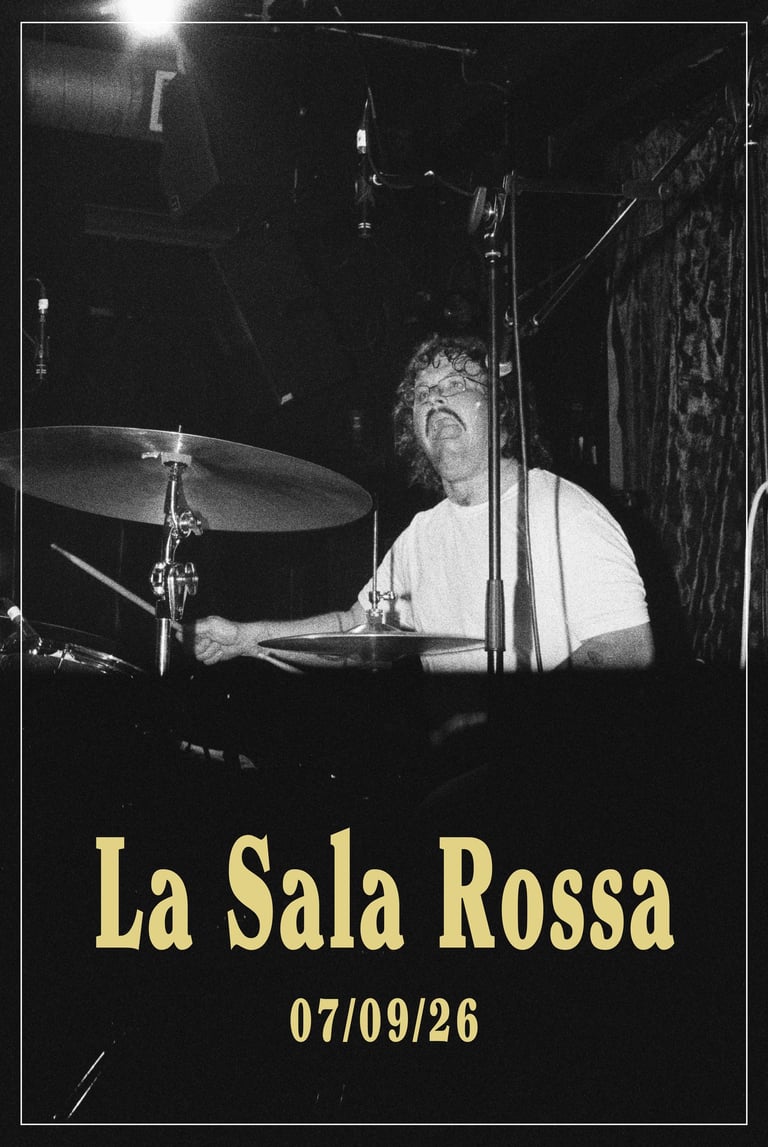
Interview conducted by Shannon McCann at La Sala Rossa
____________________________________
RMP: You’re about to play your latest album Souvenir in Montreal tonight. How does it feel to play in your city? Cause’ you’re all Montréal-based, though not from here.
HARRIS: I feel like it’s more nerve-wracking than playing an away show cause’ a bunch of people you know are hopefully gonna come.
DEMPSEY: Yeah. I’m way less scared to play out of town because it’s mostly random people.
MULCAIR: I’ve never done it before but it feels like giving birth. [laughter]
DEMPSEY: That’s awesome.
RMP: I just want to nerd out for a minute. I loved the album. It was awesome. I love the lyrics and the vibe. I wrote down a note that I felt like I was post-banger smoking a cigarette in my room, blue lighting. I really enjoyed it. It was head-spacey and deep but also the melodies were light and it made me feel, “Mmm.” Why did you choose Souvenir for the title? Cause’ I have a theory but I want to ask you.
DEMPSEY: Oh, a theory? It was kind of a placeholder name at first. We were applying for funding to make the album and the first demos that I did were for the first song and the last song, “I Want To Remember Everything” and “Exit Desire,” had perspectives on life. “Souvenir”, “Remember;” had some ties together. It was something I threw out there and wrote an application and it never got changed.
RMP: Okay, because it seems like remembering your past and the things you’ve been through. Not necessarily lamenting but just a recollection of things you’ve been through.
DEMPSEY: Totally.
MULCAIR: I think reflection and memory is really a lot of what this record is.
RMP: Yeah, it made sense. It clicked.
DEMPSEY: Yes, I like your theory.
RMP: After my first listen, my final note was: “Makes me think of becoming an adult in a world of crumbling brutalism.” I got it from your music videos too. Lots of concrete. Was there a track you had the most fun making?
MULCAIR: “I Wasn’t Fully Cooked” and “Sunrise” were, as far as I found, the most exciting. I think I had a lot more freedom rhythm-wise to play with stuff.
HARRIS: Yeah, I think I agree. “Sunrise” was probably the most fun for me.
RMP: Okay. I was reading online how you do your process, or how you did it specifically for this album. I saw it like a conversation where someone’s like, “Here’s a riff,” and someone’s like, “Okay, here are some lyrics.” It seemed like a conversation where everyone pieces together songs, and the album came together that way. What was the process like?
DEMPSEY: Yeah. I’ll usually start with a chord progression, or a melody or an idea, and then… this one I was the most hands-off of in terms of planning everything. A lot of the last album I wrote a lot of the base lines and a lot of the guitar riffs. I don’t know, I feel like a lot of it was, “Here’s a part for you to play,” on the last album. I feel like I had it mapped out a lot more on the last album so this one was a little more, “Do whatever you want to do.”
MULCAIR: [To Mischa] I think that also speaks to how we built rapport as a group and how we understand what you want your songs to sound like to a certain degree.
HARRIS: We also demo’d the last record extensively together versus this one, which we essentially didn’t demo at all.
RMP: Did it feel more freeing to put it all together like that?
MULCAIR: It was definitely more exciting.
DEMPSEY: Definitely.
HARRIS: Yeah, I feel like it keeps the songs fresher. But it’s also a bit more difficult in the process because you come up with everything without having prepared much.
RMP: Right. And you studied electroacoustics, right?
HARRIS: Yeah.
RMP: Where’d you study that?
HARRIS: At Concordia.
RMP: And what does that entail? I’m curious, I was reading about it.
HARRIS: It’s like a program about sound, recorded sound and… Electroacoustic is a style of composition that uses recorded sound to compose within the computer, or formerly the tape. I did a lot of the composition courses as well as a lot of recording courses.
RMP: And do you feel you got to use a lot of that skill for this album specifically because of the way it was recorded? Was there a lot of fine-tuning at the end?
HARRIS: Honestly yes, there was.
MULCAIR: I mean yeah, Sarah also being essentially the chief producer—what do you want to call it? Chief Engineer?
HARRIS: Yeah.
MULCAIR: Mischa’s the CEO.
DEMPSEY: Not of the recording process.
MULCAIR: We do not have a corporate structure. [laughter]
RMP: Very democratic.
HARRIS: Uh, engineer, producer, person. Whatever you call it.
RMP: Love it. So Souvenir has been gaining a lot of traction, I’ve been seeing a lot online about it. A lot of my friends are talking about it. Friends of CJSR just ranked your album #1 on their Week of July 7, 2026 chart, which was so cool to see! They put you above Kurt Vile, which is crazy.
HARRIS: On writing or on billboard charts?
MULCAIR: It was the chart.
HARRIS: Sorry, billboard. [laughter]
RMP: How did that feel?
DEMPSEY: Crazy. I mean, it was crazy to me because we started charting really high on their chart before the album even came out.
HARRIS: Yeah, this is interesting for your article. Do we spill the beans?
DEMPSEY: Well, they’ve been playing the album before it even came out, like they were playing the full album on the radio.
RMP: Wait, on the radio?
DEMPSEY: They leaked it. I don’t know if it was…
HARRIS: We don’t care.
MULCAIR: We don’t care. It was a funny story. We had an interview with Chad Bray and he was like, “We’ve been playing it for weeks!” And that was three days before it came out, and we were like, “Oh. Okay.” [laughter]
RMP: Wow! Okay.
DEMPSEY: It wasn’t like they were—they’ve been playing it, is the thing.
MULCAIR: Yeah! I don’t think we necessarily have many issues we have with the album getting played.
DEMPSEY: No!
RMP: That’s fair. And they’re from Edmonton?
MULCAIR: Yeah, I grew up there. I know Chad well. Thanks Chad! [laughter]
RMP: That’s funny. So, art is a way to send a message out into the world, be it political or loving or a call for solidarity during hard times. If knitting had an overall message, what do you think it would be?
DEMPSEY: Hmm. That’s a tough question. A message. What do you guys think? [laughter]
HARRIS: [To Dempsey] I feel like that’s on you. What my message would be is to just encourage people to start a band and make music and hang out, 'cause’ it’s a lot of fun.
MULCAIR: I was going to say the same thing.
HARRIS: It’s the best thing in the world. But Mischa would probably have a different message that’s more related to… or not.
DEMPSEY: My message…
HARRIS: We can work on it for next time.
DEMPSEY: Yeah. I like Sarah’s message.
RMP: What are some bands whose messages you resonate with?
DEMPSEY: Like what they’re doing politically?
HARRIS: Well, let’s go back to the other question because I feel like I didn’t prompt you.
DEMPSEY: Sometimes I just freeze up in an interview and I forget everything.
HARRIS: But before you said you’re writing songs about your experience as a trans person.
DEMPSEY: Yes.
HARRIS: But while you have that experience and write about it, you want the struggles or the messages you write about to be universally related to.
DEMPSEY: Yes.
HARRIS:The experience of the person. If you make anything of that.
RMP: Yeah. It’s about being human?
HARRIS: Yes, it is about being human.
RMP: Can I ask you about your identity?
DEMPSEY: Yeah, sure.
RMP: Does it feel spiritual, the gender binary?
DEMPSEY: It’s interesting. Honestly it kind of was just like a solution to a problem. A little bit. And the problem of feeling uncomfortable all the time. And the solution being doing things that make me feel less uncomfortable. I feel like there’s a big conversation about “gender euphoria” and trying to feel euphoric about your gender. I'm just like, “As long as I don’t feel really bad, that’s pretty good.” I don’t know, does that feel crazy?
HARRIS: No, that’s cool.
DEMPSEY: I don’t know. Like just feeling neutral about gender and the way that I express myself, which is hard. Being nonbinary and like sometimes having to not bring it to places like bathrooms and sometimes having to go to the men’s bathroom and going on a piss-stained toilet seat and then sometimes trying to go to the women’s bathroom ‘cause you don’t want to do that. And then kind of knowing the days when you can do one and when you can do the other one. Sometimes that’s annoying. But most of the time it’s about sort of being at peace with myself.
HARRIS: We want everybody else to mind their own business.
DEMPSEY: Very well, yeah. Like I don’t really care. I just feel good about where I am with myself. And so it doesn’t really bother me what other people think about it, to be honest.
RMP: [To Harris] Okay, so now I get to ask you a question because you know books.
DEMPSEY: Oh yeah, Sarah has a BA in English.
RMP: Really?
HARRIS: Yeah.
DEMPSEY: Sarah’s full of degrees. Sarah’s got more degrees than me and Andy combined.
MULCAIR: I have no degrees. [laughter]
RMP: Well, what are you reading right now? Be it a book, article or substack that you’re into?
HARRIS: I am currently… This is going to sound really nerdy. But I’m reading a book, 'cause I’m doing a project this summer about field recordings in Newfoundland that have to do with auditory hallucinations. So I’m rereading this book called Unsound Undead, which is a collection of essays about sonic folklore.
RMP: Wow, that is very niche.
HARRIS: That’s my answer. [laughter] Okay here’s a better answer. I’m also rereading my favourite book, The Wind-Up Bird Chronicle by Haruki Murakami.
RMP: I’ve always wanted to read something by him.
HARRIS: Great book. It’s really good. That’s a better answer.
RMP: [To Mischa and Andy] How about you?
MULCAIR: I forget what it’s called. It’s a fiction book that I’m reading. The story of Achilles. Queer romance with this young orphan. It’s called Achilles something.
RMP: The Song of Achilles? Cause’ I’ve heard of that, but I haven’t read it so I cannot confirm.
MULCAIR: But I have nothing to say about it, I’m enjoying it.
RMP: Okay, awesome.
MULCAIR: Googling it…
DEMPSEY: I’m reading a book, a novel called Americana by Chimamanda Ngozi Adichie, which is about the experiences of black Africans from Nigeria—their relationship to the West, America and England specifically. And the different experiences of being black in Nigeria versus in America. That’s sort of a dumbed down way of talking about it. There’s so much nuance in the way she’s writing about everything. It’s supremely enjoyable. It reminds me of Zadie Smith, White Teeth kind of situation. Have you heard of that?
HARRIS: I tried to read it a long time ago, but got bored. But I read The Thing Around Your Neck by Chimamanda Ngozi Adichie. That I really liked.
DEMPSEY: She’s a really good writer.
RMP: That sounds like a cool book ‘cause I’m sick of reading about Africa and the East from a Western perspective. I really like that. I’m noticing more and more young people are taking up hands-on hobbies. [To Dempsey] You started knitting in the pandemic?
DEMPSEY: Me? Oh no, I’ve been knitting since I was a kid.
RMP: Okay: I think as a response to our screen-dependent world, we’re seeing a return to physical media and things that are more tangible in general. A lot of people are knitting and sewing and painting. Do you think there’s a way to balance being chronically online and having these kinds of tangible hobbies in 2026?
HARRIS: Yes.
MULCAIR: Nobody’s gotta be online [laughs].
DEMPSEY: I just feel like people are way more aware of how much—Instagram, Spotify and Meta—their secrets being shared. And I feel like with AI, everybody is freaking out, and so having stuff that’s completely unrelated to that feels almost safe from that kind of problem of reality versus… It’s completely grounded in reality.
MULCAIR: I think you also need play and hobby and craft. I personally just started drawing again, after a long time. When I was a kid I drew all the time. Now I do a weekly drawing session with no pressure, with no… “I’m not trying to produce something.” There’s no monetary value attached to it. It feels so freeing. And just spending a minute doing whatever the hell you want to do.
DEMPSEY: That’s awesome.
RMP: Souvenir has some deep songwriting, strong emotive lyrics. Has it taken time to practice to really translate your ideas onto the page?
DEMPSEY: Yeah, I still feel like I’m kind of… There’re still hiccups and waves to get through them. I had to do the artist’s way to do this album. I feel like I got an immense amount of block, and then also I had to ask Sarah to help me finish the lyrics on those songs.
HARRIS: Not lots.
DEMPSEY: Three or four, I think, which is almost half. It was good because we had the bed tracks, like the guitars and the drums and the bass. But no vocals for like six… no that’s not true.
MULCAIR: No leads.
DEMPSEY: No leads! That’s true. For a good couple of months.
MULCAIR: And what did we do in those couple of months?
DEMPSEY: What do you mean?
HARRIS: We toured in Europe.
MULCAIR: It was cool because we got to spend some time playing a few of the new songs to people. We got to spend some time perfecting and remembering the pieces that we had done the tracks for. But I think that also having a bit of a gap where we were actively performing gave us a chance to sort of reflect on what the finishing touches would be.
DEMPSEY: Totally.
MULCAIR: And also definitely informed the sound of the album.
HARRIS: We collected inspiration. We got to see a bunch of bands. 'Cause you’d see 20 bands to be inspired by.
RMP: What’s your favourite memory from Europe? From your tour for the last album?
HARRIS: We had a really fun night in Berlin at this Irish pub. It was Canadian.
RMP: It was Canadian?
HARRIS: It was Canadian, but it was…
DEMPSEY: Canadian-Irish pub.
HARRIS: The vibes in there were really good.
MULCAIR: I would speak to the venue we played in Prague. Klubovna.
DEMPSEY: Klubovna.
HARRIS: Oh yeah. That was fun.
MULCAIR: The headliner was this, sort of like a contemporary take on traditional Czech/Folk/Rock/Pop. And the crowd totally showed up for that. We got to play before them. Is that correct? Or did we play after?
DEMPSEY: We played in the middle.
HARRIS: Middle, yeah.
MULCAIR: Right. It was just a truly cultural experience in the sense. A lot of youth in Prague who just came out to this little hole-in-the-wall bar, and it was the most excellent experience.
DEMPSEY: Most excellent. I really liked our Leeds show, honestly. I love Leeds. Leeds is amazing. I almost wanted to move to Leeds after the first time I’d been there. We were at this venue called Hyde Park Book Club, which is just full of books and it’s just a very chill hangout spot. Leeds is a very student town. We played with a young queer band who had an awesome manager.
HARRIS: Yeah. One of their girlfriends was their manager. She was always hustling.
MULCAIR: They’re called Junk.
DEMPSEY: They’re awesome. Shoutout Junk.
MULCAIR: And then we also played with Bonnie Trash.
DEMPSEY: Bonnie Trash, yes!
RMP: Do you have any projections for future music? Any genres you want to dabble in? Beause you had a band before knitting?
DEMPSEY: I did. Yeah. That was more punk, kind of. This is definitely more… I mean we get really loud but tonally it’s a lot more reserved. I would love to go more in… I don’t know. I like not being locked into one genre, which I think also is why we have such a hard time being like, "What is our genre?” Because we take influence from a lot of different genres. It would be fun to go in a more post-punky direction. But it would also be fun to explore some more experimental types of songs. Like the last song on the album, which is all synth and guitar and stuff.
RMP: [To Harris and Mulcair] You guys have any genres you want to dabble into?
MULCAIR: I don’t know. We spent maybe 30 seconds on a sludgey, shoegazey element for this record.
DEMPSEY: Oh, you mean the intro to…
MULCAIR: Yeah. The intro to “I Wasn’t Fully Cooked”. We just have a really slow-driving, pulsing piece. I really liked how it came out. I’ll say that. It‘s maybe something I’d want to do again.
RMP: That might be an early question, 'cause’ you’re just starting your tour.
HARRIS: I agree with everyone else, but it’s like refining the sound that we’ve been cultivating together.
RMP: It’s a really cohesive album, it flowed really nice together.
HARRIS: Thanks.
RMP: Kind of a controversial question: best poutine in Montreal? [laughter]
DEMPSEY: I’ll go, Orange Julep. Boom. Easy.
MULCAIR: I used to say Patati Patata but I have since grown up. No, it is good, but I think I prefer the poutine at Ma Poule Mouillée, which is across the street from La Banquise. Super.
DEMPSEY: Wow.
HARRIS: Not really a poutine head, but I’ll say… What’s that place on St. Hubert? The King of Smoked Meat?
MULCAIR: Le Roi du Smoked Meat?
HARRIS: Le Roi du Smoked Meat. I like that place.
DEMPSEY: I actually might have to amend my statement because I used to live down the street from a place called Hot Dog Mont-Royal.
RMP: On Mont Royal Avenue?
DEMPSEY: It’s on Mont Royal, yeah. That actually is my favourite poutine.
HARRIS: But I also fuck with Nouveau Système.
DEMPSEY: Nouveau Système, yeah!
RMP: Oh! I’m asking mostly for myself.
MULCAIR: When you said you moved recently, did you mean you moved from Ottawa?
RMP: No, I’ve been here almost two years. But yeah, I was in Ottawa for eight. I’m right by Chez Claudette.
DEMPSEY: Chez Claudette is very good.
HARRIS: That’s the best poutine.
MULCAIR: That’s the best late night spot for sure.
RUNNING MAN PRESS
CoNTACT
info@runningmanpress.ca
© 2024. All rights reserved.
ads@runningmanpress.ca