
INTERVIEW: Poet, Lyricist and Activist Aja Monet
INTERVIEW
Shannon McCann
7/14/202610 min read
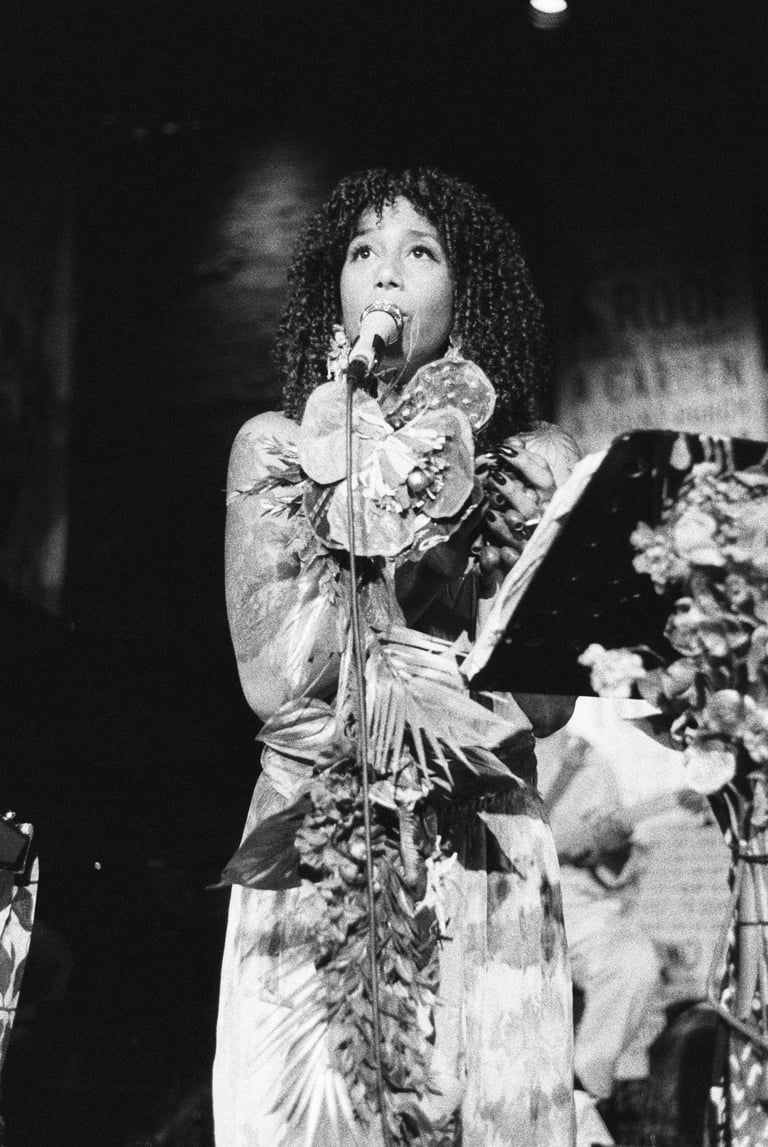
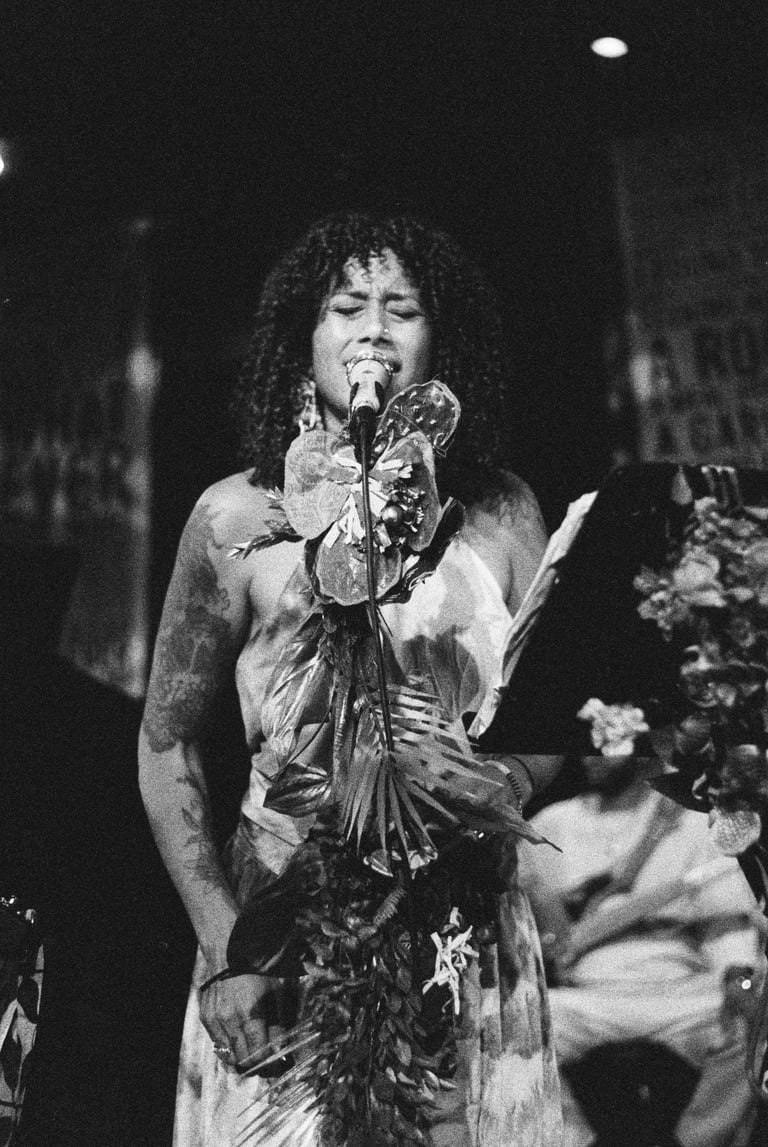
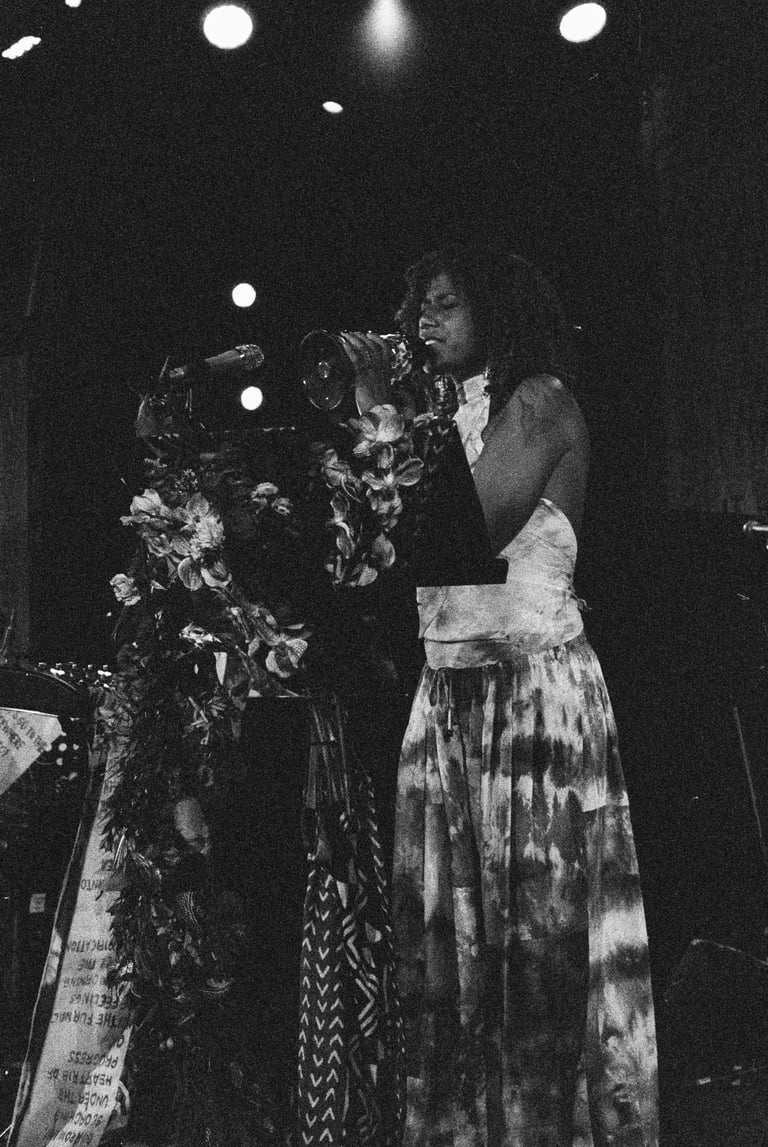
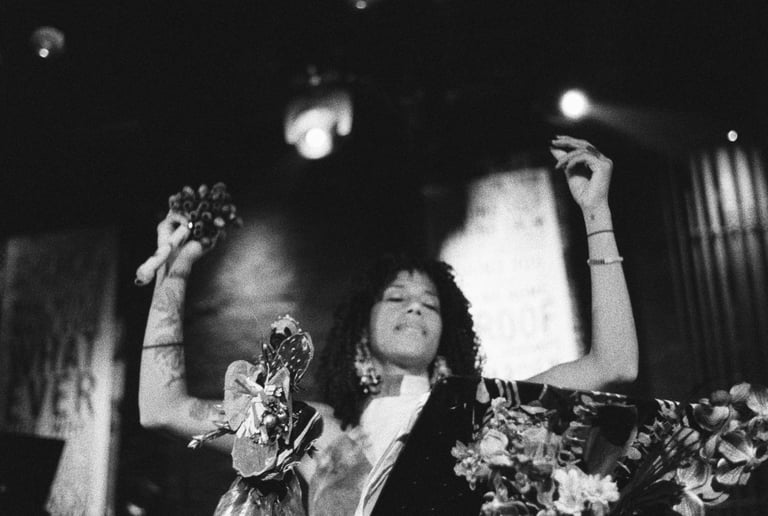
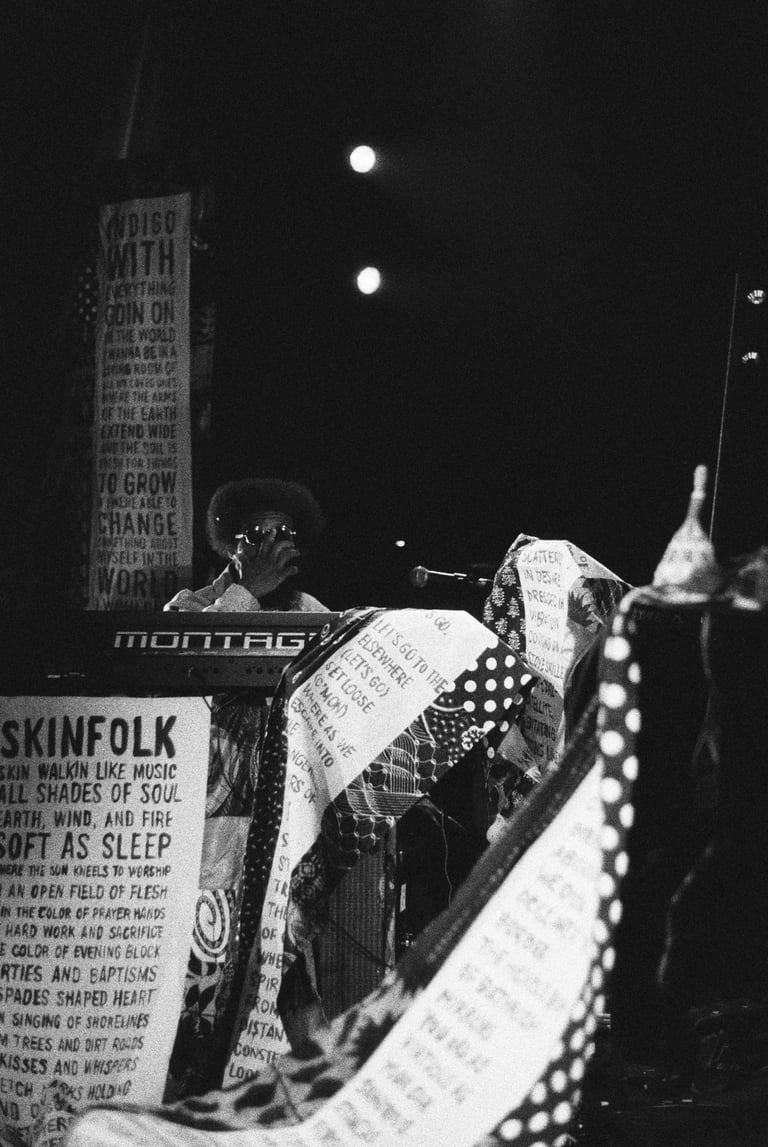
Aja Monet is a Los Angeles-based poet, lyricist and activist who was raised in Brooklyn. During her recent visit to Montreal to perform at Le Studio TD for Jazz Fest, the surrealist blues poet's words were accompanied by her live band consisting of talented jazz musicians. Running Man was able to speak with Monet shortly before her performance.
Interview conducted by Shannon McCann
____________________________________
RMP: Just off the bat: Is there a book that’s rewired your brain?
MONET: Hmm. I think anything by Ntozake Shange. She’s a poet, an incredible playwright, storyteller.
RMP: From New York?
MONET: She was based in NY, but she’s no longer with us. She is… I think actually she lived all over. She lived in St. Louis. She lived in a few places. I don’t know where she last was before she passed, but I would think anything by her really gave me a lot of insight into the way language could be used on and off the page.
RMP: Okay, because that’s kind of your thing, with poetry. I just appreciate—it’s just such craftwork, every word. There’s so much depth to every word you've chosen. “Working class musicians;" it made me think of all of my friends.
MONET: That’s awesome, thank you for that. Thank you for listening.
RMP: So, I think making art is, in a way, an act of rebellion. Right now, a lot of people, and a lot of young people, are very mad with the world. We’re both highly aware of the systems in place and feel utterly powerless to make change. I think this is why art’s so important, it’s a voice. Even if you can’t articulate, someone can maybe articulate something you feel inside. Do you think it’s true that hard times birth powerful art?
MONET: Hmm. Not all hard times birth powerful art, but I do think that powerful art can come from hard times, when someone learns how to—when someone’s present enough to really process and transmute whatever the hard times is conveying. Cause’ you hope that through hard times you can kind of come to some either realization about yourself or about your connection to the world and the community that you’re in.
I think that through that experience, if you will, some artists are born through those types of experiences. Not all artists are born through those times or experiences, but it is fertile ground for an artist to come to be. Cause’ it’s in those experiences that you’re truly tested in terms of how creative, how innovative you can be. You have to learn to trust. And then you have to learn to trust your gut, you know? If you got in by other ways of law that aren't manmade. If there are other kinds of beings, entities, or ways of being in the world that aren't so in the head; I think it forces you to really, I don't want to say reckon with, but there is some kind of struggle between the head and heart through hard times.
RMP: Yeah.
MONET: And I think it’s in that struggle that you come to—there’s a certain kind of surrendering that takes place that if we lean into it—humbles one in such a way that only creativity, only innovation can come from. I think art is really moving from the heart versus the head. It's a place of being really creative and imaginative and courageous at times. So I think hard times teach us what we’re capable of, and in the best ways, and in sometimes the worst ways: it really shows us our courage to just show up and rise to an event or a moment. You know?
RMP: So, in a way, would you say that the systems in place that we’re seeing, can be like a wall you can touch, and when you’re connecting with your heart, it’s more like the air you breathe? And it’s important to stop looking at the wall sometimes and just breathe the air?
MONET: Yeah, I think.
RMP: Sorry.
MONET: No, you make a lot of sense.
RMP: You said, “fertile grounds,” and I kind of stuck with that for a minute.
MONET: I think we feel deeply. Many of us are sentient beings, that’s why we’re here, you know? Like we have a lot of feelings, and I think having the feelings is not—we often judge our feelings. So more than honouring them and acknowledging that they're information—there’s a lot of material there for us to actually process—that it’s something that in the process of going through with feeling emotions that actually we can come through a new understanding; new ideas about ourselves. Maybe new ways of making those ideas felt.
You know, hard times, you feel them, and they don’t feel—it’s not convenient. It tests you, it challenges your comfort, your risks and your capacity. Your capacity to imagine, your capacity to be innovative, your capacity to feel deeply. So, I would say that yeah, I don’t know. I don't have a lot of answers, but I grapple with these things. I question them myself and I work through them in myself and I sometimes come to some revelation about it, but it's still day to day, you know?
MONET: And I want to say that I resonate with the fact that it’s hard and there are larger systems at play, but usually the metric of one’s, I want to say, effectiveness at making art or being courageous is the capacity to feel and to move with that feeling, to do something with that feeling, that positions one in a way such that you move differently, whether that be better or with more love, more care, more will to connect, more will to move outside of just yourself in the isolation that those feelings can sometimes bring. I think part of the system is that it’s meant to make you feel isolated. It’s meant to make you feel alone, so whatever we can do to move through that isolation… because when you get into that space you can get really desperate.
RMP: And you turn to the internet for answers.
MONET: Yeah. And then you find yourself in a sense of despair. I think what art allows us to do is to actually feel our creative capacity to do something else. There are other ways of being, there are other ways of feeling and experiencing the world that we can aspire to, that we can co-create and collaborate on that lets us say “This doesn't have to be this way,” “This is not the way,” “Who set things up like that?” Often it creates questions more than answers. Art invites more questions than answers. You don’t get to a place where you’re like, “I know it all.” If anything, you're like, “Actually I don't know it all, and the fact that I don't know it all makes me more curious about what else there is to this living.”
RMP: So, in that way would you say empathy in a way is revolutionary?
MONET: For sure. You know, I think empathy—I wouldn't say empathy alone, but compassion.
RMP: Imagining on behalf, putting yourself in someone else's shoes.
MONET: Putting yourself in your shoes first. Because a lot of the time we try to assume what other people are feeling. Or what other people will, or don’t feel. We can dehumanize one another and create excuses or reasons why somebody else is not like us and therefore doesn't have the capacity to feel or be impacted by the decisions we make. So, I think the part of it is: you gotta get in your own shoes first, you know? And maybe there are no shoes. You just gotta get your feet on the ground and touch the grass.
Touch the grass has been a big theme for me as a metaphor. I think we’ve got to get to a place where we can touch the grass and feel again, and maybe not feel even again but maybe for the first time for many people. So, I think, yeah once you can feel deeply the spectrum of your own emotions, you know how to have capacity for others. You know? Because a lot of us, we can't even sit with our own emotions, so we don't even know how to help, cause then there has to be a co-regulation at some point. If you can't regulate yourself, you don't know how to help regulate someone else.
RMP: And how is it possible to even understand—that’s why people are so fun. People are so interesting.
MONET: They are. Humans are really, I mean… you gotta love them even as much as they get on your nerves.
I’m learning to have more compassion because somebody set this up this way. We are in a crisis, and this was set up to be this way, so we become desperate for very remedial solutions and don't believe that we’re worthy of more. So, I think there's a level of frustration and anger that we have about the state of things, and we should. But we need to always examine who's at fault. Right? What are the things at play that are creating the conditions that we’re living in?
MONET: It’s important. It’s important to do it in real life and not just through the screen.
RMP: Yeah, you can’t put it in 280 characters.
MONET: No, and also people when they have to face you and your gestures and humanize; I think a lot of that is lost on this generation, and so I feel like the more we can rely on people and reinstill those values, the better. But go on cause’ I'll keep talking.
RMP: I want to ask you one last question. I checked out your last livestream, loved it, and—
MONET: Wait, when’d I have a livestream? Oh, I was probably being silly. I was being like, “Come out to the show!”
RMP: No, it was great. And you mentioned something about a living room tour. Going and doing poetry nights in people's living rooms, and I mentioned that’s something we do in Montreal a lot.
MONET: Oh yeah, I saw your comment.
RMP: Yeah! I go to poetry nights, there’s roughly 40 people in a room, and it feels exactly like the kind of thing you’re describing. We’re all connecting in person with people from all over the world. We have people from the States. We had someone from Africa, from Ghana recently, and gave poems, and I can’t even explain the amount of self-synthing that goes on. It just opens this understanding and it's okay to not necessarily—it’s just magic.
I just wanted to ask you, you mentioned "intimate" “less algorithms”: Can you describe your vision in regard to living room tours? That idea, if that’s something you’d be interested in?
MONET: No, I’m gonna do it, I know it. I’m already gonna do it. I think the thing I love is that I used to do it in my home. I’d invite people when I was living in Florida. We’d invite people to come to our home, into our backyard and into our living room, and it was some of the most meaningful, connecting work because you actually… One, you're trusted. Two, you have to really learn to read people. And you become sort of, yeah, there's no—it’s not easy to just live it—to turn into a character or an identity cause’ you have to sit and face them and talk with them. We were trying to get people offline from disagreeing, even just doing debates in the house. “Okay, you don't like this song from this pop star? Let's sit in a room and talk about it,” rather than go back and forth on Twitter and trying to get a bunch of retweets. So, I think for me it's just presence. You know? It ultimately comes back to presence and connection. How do we have genuine sincere connections with each other?
RMP: It’s working.
MONET: Yeah. I do it in my house sometimes. I do jam sessions in my house. It becomes really really important when others see you doing that work and then they help you facilitate because facilitation is such a labour that people take for granted. And so, I give thanks to those who know how to curate space and hold space and create space for people to gather because a lot of people take that for granted. You know? Because everything’s so co-opted and corporate. But the intimacy of space and being able to allow someone into your home, that’s such a special thing. It’s the first place we organize is in our homes.
So, I think I look forward to that being a place to start from, then that rippling out into the ether. You know? So yeah, we’ll see. It’ll probably start in my house, for sure.
RMP: What are you reading at the moment?
MONET: I’m revisiting “The Famished Road” by Ben Okri. I just did a reading. I was a part of an African festival in Berlin called Afrolution and Ben Okri was there. Interesting fellow. We had some little back and forth with ideas. But very very profound writer and one of my favourite writers, so I’m revisiting one of his books.
RMP: I know you have “Florida Water,” you published recently. Do you have another book coming out? And would you ever write a novel?
MONET: I really want to. I really really do. There’s another Arundhati Roy book that I’d say people should read, and it’s the one that just came out about her mother: “Mother Mary Comes To Me.” I just finished that book.
RMP: How was it?
MONET: Really good. Very very good. I realize, actually it’s giving me the courage to write my memoir about my grandmother and my mother.
RMP: Cause’ you have one about your mom?
MONET: I had a book of poems that touches on mothers…
RMP: Yeah, Freedom Fighter?
MONET: Yeah, “My Mother Was a Freedom Fighter” and other mothers. But a memoir’s different. So, I’m trying to figure out how to write about these very personal things without putting everything out too deep, you know? So, we’ll see.


RUNNING MAN PRESS
CoNTACT
info@runningmanpress.ca
© 2024. All rights reserved.
ads@runningmanpress.ca