
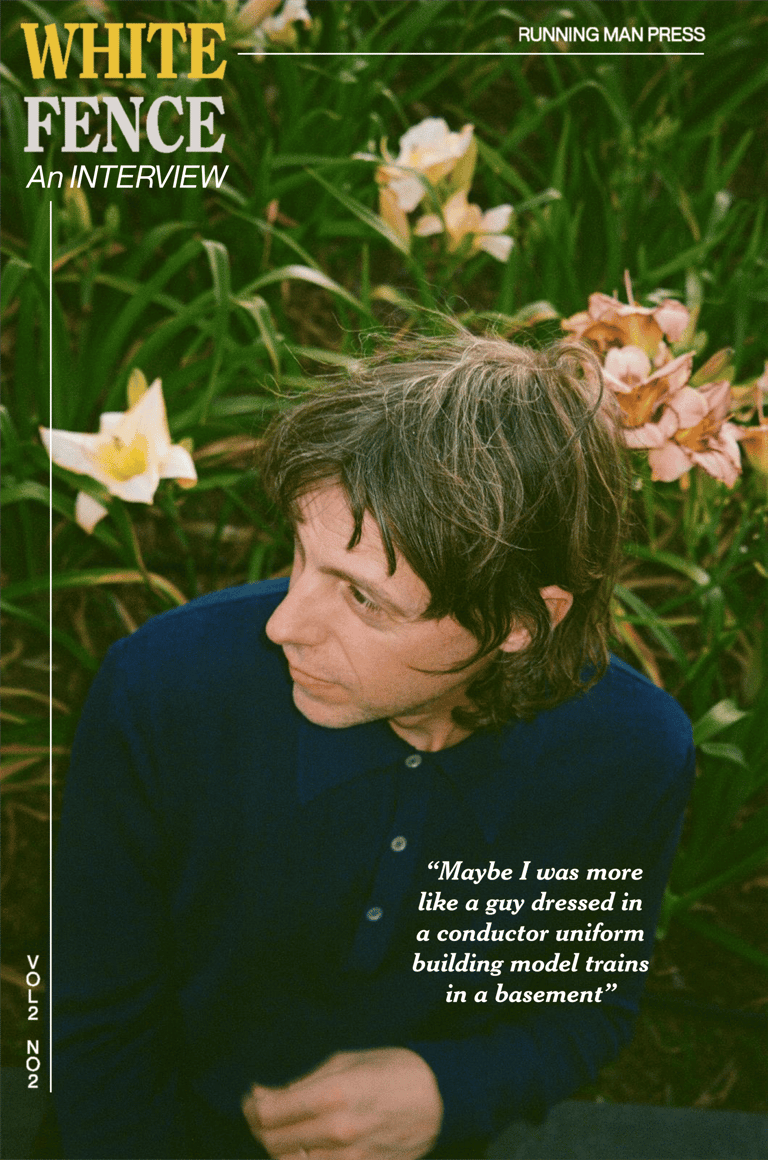
INTERVIEW: Tim Presley of White Fence on the making of his new album Orange
INTERVIEW
6/2/20267 min read
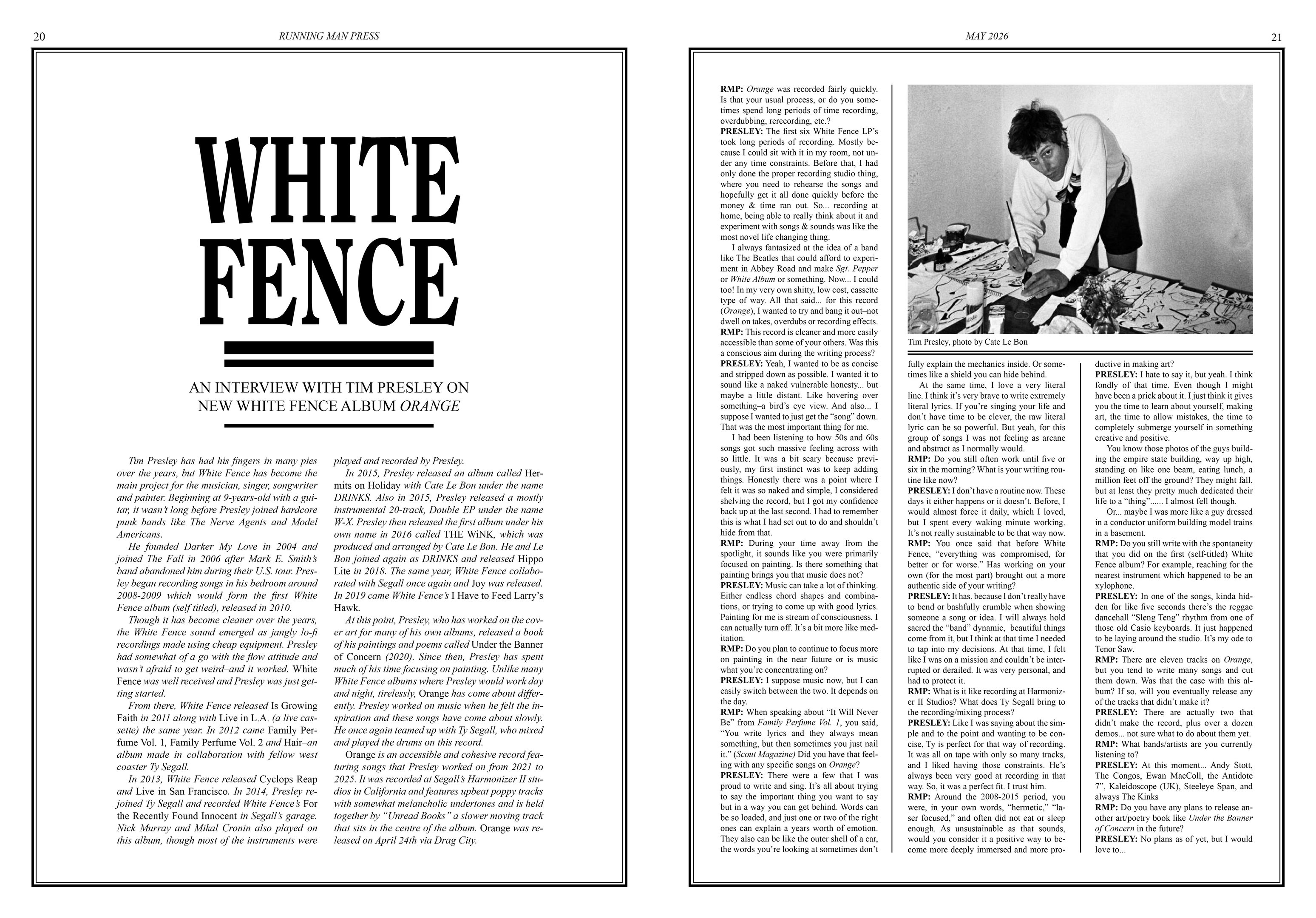
Tim Presley has had his fingers in many pies over the years, but White Fence has become the main project for the musician, singer, songwriter and painter. Beginning at 9-years-old with a guitar, it wasn’t long before Presley joined hardcore punk bands like The Nerve Agents and Model Americans.
He founded Darker My Love in 2004 and joined The Fall in 2006 after Mark E. Smith’s band abandoned him during their U.S. tour. Presley began recording songs in his bedroom around 2008-2009 which would form the first White Fence album (self titled), released in 2010.
Though it has become cleaner over the years, the White Fence sound emerged as jangly lo-fi recordings made using cheap equipment. Presley had somewhat of a go with the flow attitude and wasn’t afraid to get weird–and it worked. White Fence was well received and Presley was just getting started.
From there, White Fence released Is Growing Faith in 2011 along with Live in L.A. (a live cassette) the same year. In 2012 came Family Perfume Vol. 1, Family Perfume Vol. 2 and Hair–an album made in collaboration with fellow west coaster Ty Segall.
In 2013, White Fence released Cyclops Reap and Live in San Francisco. In 2014, Presley rejoined Ty Segall and recorded White Fence’s For the Recently Found Innocent in Segall’s garage. Nick Murray and Mikal Cronin also played on this album, though most of the instruments were played and recorded by Presley.
In 2015, Presley released an album called Hermits on Holiday with Cate Le Bon under the name DRINKS. Also in 2015, Presley released a mostly instrumental 20-track, Double EP under the name W-X. Presley then released the first album under his own name in 2016 called THE WiNK, which was produced and arranged by Cate Le Bon. He and Le Bon joined again as DRINKS and released Hippo Lite in 2018. The same year, White Fence collaborated with Segall once again and Joy was released. In 2019 came White Fence’s I Have to Feed Larry’s Hawk.
At this point, Presley, who has worked on the cover art for many of his own albums, released a book of his paintings and poems called Under the Banner of Concern (2020). Since then, Presley has spent much of his time focusing on painting. Unlike many White Fence albums where Presley would work day and night, tirelessly, Orange has come about differently. Presley worked on music when he felt the inspiration and these songs have come about slowly. He once again teamed up with Ty Segall, who mixed and played the drums on this record.
Orange is an accessible and cohesive record featuring songs that Presley worked on from 2021 to 2025. It was recorded at Segall’s Harmonizer II studios in California and features upbeat poppy tracks with somewhat melancholic undertones and is held together by “Unread Books” a slower moving track that sits in the centre of the album. Orange was released on April 24th via Drag City.
____________________________________
RMP: Orange was recorded fairly quickly. Is that your usual process, or do you sometimes spend long periods of time recording, overdubbing, rerecording, etc.?
PRESLEY: The first six White Fence LP’s took long periods of recording. Mostly because I could sit with it in my room, not under any time constraints. Before that, I had only done the proper recording studio thing, where you need to rehearse the songs and hopefully get it all done quickly before the money & time ran out. So... recording at home, being able to really think about it and experiment with songs & sounds was like the most novel life changing thing.
I always fantasized at the idea of a band like The Beatles that could afford to experiment in Abbey Road and make Sgt. Pepper or White Album or something. Now... I could too! In my very own shitty, low cost, cassette type of way. All that said... for this record (Orange), I wanted to try and bang it out–not dwell on takes, overdubs or recording effects.
RMP: This record is cleaner and more easily accessible than some of your others. Was this a conscious aim during the writing process?
PRESLEY: Yeah, I wanted to be as concise and stripped down as possible. I wanted it to sound like a naked vulnerable honesty... but maybe a little distant. Like hovering over something–a bird’s eye view. And also... I suppose I wanted to just get the “song” down. That was the most important thing for me.
I had been listening to how 50s and 60s songs got such massive feeling across with so little. It was a bit scary because previously, my first instinct was to keep adding things. Honestly there was a point where I felt it was so naked and simple, I considered shelving the record, but I got my confidence back up at the last second. I had to remember this is what I had set out to do and shouldn’t hide from that.
RMP: During your time away from the spotlight, it sounds like you were primarily focused on painting. Is there something that painting brings you that music does not?
PRESLEY: Music can take a lot of thinking. Either endless chord shapes and combinations, or trying to come up with good lyrics. Painting for me is stream of consciousness. I can actually turn off. It’s a bit more like meditation.
RMP: Do you plan to continue to focus more on painting in the near future or is music what you’re concentrating on?
PRESLEY: I suppose music now, but I can easily switch between the two. It depends on the day.
RMP: When speaking about “It Will Never Be” from Family Perfume Vol. 1, you said, “You write lyrics and they always mean something, but then sometimes you just nail it.” (Scout Magazine) Did you have that feeling with any specific songs on Orange?
PRESLEY: There were a few that I was proud to write and sing. It’s all about trying to say the important thing you want to say but in a way you can get behind. Words can be so loaded, and just one or two of the right ones can explain a years worth of emotion. They also can be like the outer shell of a car, the words you’re looking at sometimes don’t fully explain the mechanics inside. Or sometimes like a shield you can hide behind.
At the same time, I love a very literal line. I think it’s very brave to write extremely literal lyrics. If you’re singing your life and don’t have time to be clever, the raw literal lyric can be so powerful. But yeah, for this group of songs I was not feeling as arcane and abstract as I normally would.
RMP: Do you still often work until five or six in the morning? What is your writing routine like now?
PRESLEY: I don’t have a routine now. These days it either happens or it doesn’t. Before, I would almost force it daily, which I loved, but I spent every waking minute working. It’s not really sustainable to be that way now.
RMP: You once said that before White Fence, “everything was compromised, for better or for worse.” Has working on your own (for the most part) brought out a more authentic side of your writing?
PRESLEY: It has, because I don’t really have to bend or bashfully crumble when showing someone a song or idea. I will always hold sacred the “band” dynamic, beautiful things come from it, but I think at that time I needed to tap into my decisions. At that time, I felt like I was on a mission and couldn’t be interrupted or derailed. It was very personal, and had to protect it.
RMP: What is it like recording at Harmonizer II Studios? What does Ty Segall bring to the recording/mixing process?
PRESLEY: Like I was saying about the simple and to the point and wanting to be concise, Ty is perfect for that way of recording. It was all on tape with only so many tracks, and I liked having those constraints. He’s always been very good at recording in that way. So, it was a perfect fit. I trust him.
RMP: Around the 2008-2015 period, you were, in your own words, “hermetic,” “laser focused,” and often did not eat or sleep enough. As unsustainable as that sounds, would you consider it a positive way to become more deeply immersed and more productive in making art?
PRESLEY: I hate to say it, but yeah. I think fondly of that time. Even though I might have been a prick about it. I just think it gives you the time to learn about yourself, making art, the time to allow mistakes, the time to completely submerge yourself in something creative and positive.
You know those photos of the guys building the empire state building, way up high, standing on like one beam, eating lunch, a million feet off the ground? They might fall, but at least they pretty much dedicated their life to a “thing”...... I almost fell though.
Or... maybe I was more like a guy dressed in a conductor uniform building model trains in a basement.
RMP: Do you still write with the spontaneity that you did on the first (self-titled) White Fence album? For example, reaching for the nearest instrument which happened to be an xylophone.
PRESLEY: In one of the songs, kinda hidden for like five seconds there’s the reggae dancehall “Sleng Teng” rhythm from one of those old Casio keyboards. It just happened to be laying around the studio. It’s my ode to Tenor Saw.
RMP: There are eleven tracks on Orange, but you tend to write many songs and cut them down. Was that the case with this album? If so, will you eventually release any of the tracks that didn’t make it?
PRESLEY: There are actually two that didn’t make the record, plus over a dozen demos... not sure what to do about them yet.
RMP: What bands/artists are you currently listening to?
PRESLEY: At this moment... Andy Stott, The Congos, Ewan MacColl, the Antidote 7”, Kaleidoscope (UK), Steeleye Span, and always The Kinks.
RMP: Do you have any plans to release another art/poetry book like Under the Banner of Concern in the future?
PRESLEY: No plans as of yet, but I would love to...


RUNNING MAN PRESS
CoNTACT
info@runningmanpress.ca
© 2024. All rights reserved.
ads@runningmanpress.ca