
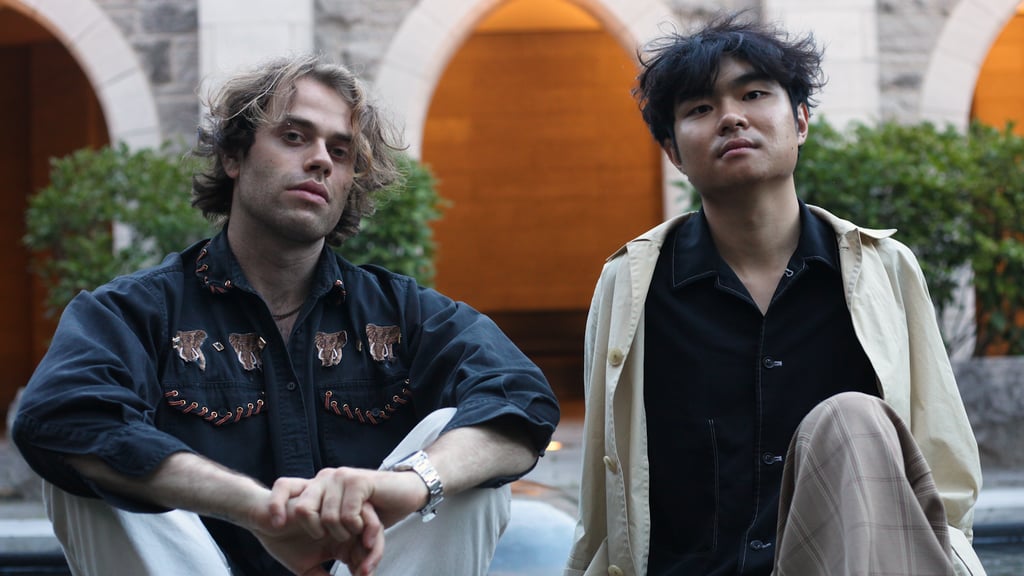
INTERVIEW: Toronto-ish indie-experimental Ira Dot on their debut LP
INTERVIEW
Xavier Xin
2/24/202610 min read
Ira Dot is an experimental-indie duo formed in Toronto and now split between Montreal and Philadelphia. It consists of singer-songwriter Eddy Wang and producer Ryan Akler-Bishop. Their first record In Blue Time is an eclectic genre hybrid (slacker rock, electropop, sound collage, post-rock, etc.), a meditation on the colour blue, and a tenderhearted study of melancholia.
—
The first songs on In Blue Time dwell in the interim before the inevitable has to happen. They're constantly referencing some unfortunate act that must occur soon; they situate themselves in an in-between space. Given the title’s reference to time, could you tell me what In Blue Time means to you individually?
RAB: I impulsively wrote down that title so we could submit our first grant. Eddy accepted it as a working title. As we kept applying for more grants, I kept using it again and again. Eddy was uncertain about it, but I had a hunch it was the right title. This is a manipulative strategy, but I figured if I put it down on enough grant applications, it would worm its way into Eddy’s mind and he’d accept it through familiarity. Perhaps that’s how parents also come to love their children.
EW: I’m pretty easily manipulated. [Laughs.]
RAB: Sure enough, he grew to like it. As for its “meaning,” there’s a plethora of ways you can interpret blue time. I have a lousy sense of rhythm, so I have this mental image of someone calling me out for playing out of time. I imagine myself retorting, “No, dude, I’m just playing in blue time,” as if there’s an alternative musical temporality that isn’t based around metre but, rather, something more de-structured and untranslatable.
EW: I thought it was a pun on “in due time” since we took so long to finish the album. When Ryan initially came up with the title, we were talking about The Blue Nile and their album Hats. We talked a lot about blue art and the colour itself during the recording process of the album. Blue is my favourite colour. I’m wearing a blue shirt right now. I love what Ryan said about time though. Here’s what Deleuze and Guattari say about playing out of time [grabs a copy of A Thousand Plateaus from his shelf]:
“In the simplest terms, Boulez says that in a smooth space-time one occupies without counting. Whereas in a striated space-time, one counts in order to occupy. He makes palpable or perceptible the difference between nonmetric and metric multiplicities [...] At a second level, it can be said that space is susceptible to two kinds of breaks: one is defined by a standard, whereas the other is irregular and undetermined, and can be made wherever one wishes to place it [...] Returning to the simple opposition, the striated is that which intertwines fixed and variable elements, produces an order and succession of distinct forms, and organizes horizontal melodic lines and vertical harmonic planes. The smooth is the continuous variation, continuous development of form; it is the fusion of harmony and melody in favor of the production of properly rhythmic values, the pure act of the drawing of a diagonal across the vertical and the horizontal.”
So, smooth space doesn’t really follow syncopated time. It’s more arrhythmic and not interested in the correctness of notes. Of course, In Blue Time isn’t avant-garde music, but there are elements of a smooth rendering of musical time on our record.
Most of the songs end as the lyrics end. There’s rarely a pure instrumental part after the lyrics run their course, except for “Melancholia.” What inspired the decision to let this song keep running after the voice ends?
EW: I like to repeat a line over and over again. When a lot of these more lyric-based songs were written, I found myself ending songs by repeating a phrase that holds significance to me, like a maxim or a chant. The end of “Melancholia” is a moment where you hear my mom’s voice, who is also on “Goose Eggs” and “Days.” On “Melancholia,” she becomes an aesthetic representation of melancholia. One aspect of melancholia is its amorphousness. It’s a loss that you can’t totally decathect from or, in fact, name: you know that you have lost but not what you have lost. On “Melancholia,” my mother’s Beijing opera vocals come in ambiently and the record ends in an oceanic dissolve.
RAB: The pop song is striated musical space epitomized. Something like “Melancholia” is determined by standard music conversations; it’s melody and rhythm-driven. We even mixed the drums really loud. But with this song, I wanted to see all of those musical conventions break apart and dissolve into something more amorphous. The second half of “Melancholia” started as a demo I made around summer of 2020 from a choir sample and construction site field recordings. Impulsively, I titled it “Endings,” so it always felt like a conclusion to something. Eddy suggested we meld it onto the end of “Melancholia.”
EW: On a lot of the record, there’s a tightrope we’re walking around the stability of genre. Emotionally, the songs are always collapsing and changing. On “Bodies” and “Melancholia,” the ends of each side of the vinyl, the tracks allow themselves to dwell, at least for moments, in this smooth space.
Starting from “Clouds,” the arrangements really change. They’re more smooth and melodic there, but it becomes more harsh, dynamic, and electronic as it goes on until “Anyways.” What motivated this stylistic switch-up?
RAB: We never conceived of a cohesive trajectory for how genre would mutate across the album. We just made a bunch of songs following our aesthetic instincts. Our curiosities were pretty eclectic at the start of making this album because we had no sense of what Ira Dot would be. The first song Eddy and I made together was a rap song; Eddy was spitting mad bars. For the album, we ended up grouping tracks together during sequencing to begin with something more melodic, break that apart, crawl through rugged terrain, and then coalesce at the end in open air.
EW: It’s definitely a porcupine-esque album. In our initial sequencing, we placed “Days” quite early. Matt Smith [aka. Prince Nifty] gave us some advice for the record. He told us we’d lost the plot and “Days” was a Side B song. He gave me a pep talk on the importance of sequencing, so Ryan and I went to the drawing board to find a narrative for the album, even if it’s not a linear narrative. I always saw Side A as my voice singing more lonesome and romantically down on his luck. The first four songs focus on the rocky roads of relationality, rendered through an earnest croon à la Jonathan Richman or Daniel Johnston. Then “Bodies,” a song about accepting death, stages a reinvention of both the record’s style and use of vocals, since it ends with a choir. After that, on “Souvenirs” we have a poem from Fan Wu and Ryan sings the end. On “Blue Stucco,” Ryan sings the second verse. On “Days,” it’s our friend Amy, my mother, and then Ryan at the end again. The album turns from being more personable to dwelling with these moments of collective togetherness. At the end, “Melancholia” has only my solo voice, so it closes up, as all social moments must.
RAB: And yet, the album doesn’t end on your voice. It ends on your mom’s. Perhaps we’ve gone full cycle and returned to the site of you in the womb. [Laughs.]
EW: [Laughs.] Right, that’s what all those watery sounds on “Melancholia” must be.
Throughout the album, there’s a recurring phrase in the lyrics: “There’s no why.” On “Bodies,” you propose this question, but you don’t really give an answer. Instead, you dissolve the question. Do you feel like this line “there’s no why” aligns with a larger philosophy of yours?
EW: For Wittgenstein, some problems of life emerge because we have a misunderstanding of the limits of our language. They’re not the right questions to ask, or not using the right words. I think philosophy helps us to determine what questions are worth asking: what is revealed to us in this world is decided by what inquiries we bring into it. And “why” might not always be the word we want to be using for some of our life questions.
The problem of causality has been a big unsolved problem in the history of philosophy, and I’m not sure there exists a definitive explanatory framework that’s going to satisfy every question asking for a “why.” We can’t trace the causes of everything. Even if we could, it’d be a highly complex system we couldn’t understand. Having “no why” speaks to a larger existential state of living. A lot of life is simultaneously trying to find meaning and accepting when meaning is not apparent. We have to negotiate both tendencies, in my view.
RAB: Those are Eddy’s lyrics, so I don’t necessarily agree. I think there is always a why. I think there’s always causality, even when the factors that ricochet to create the present are obscure. I think the world as we know it is entirely formed through actions dictated by the conditions of labour, colonialism, etc. That said, it’s not humanly possible to parse through this massive web of causality, nor is it worthwhile. Sometimes, for your sanity, you have to accept not grasping the why. But ultimately, “why” is a question for science and “how” is a question better suited for art.
EW: In Adorations, Jean-Luc Nancy speaks about the fortuitous character of existence, of the world and our beings. Instead of thinking of our world as being the result of, he writes that “it takes place, it is there.” Indeed, it is the taking-place of the world that opens us to adoration.
I also love how Alain Badiou describes the event as a thunderbolt or caesura, as a chance encounter that disrupts the regular causal flow of our everyday lives. My own appraisals of undecidability and the unnamable is why I’m pro-“no why,” at least for some cases. Some things might need explanation, but some things may not.
Let’s talk about “Souvenirs.” That one and “Blue Stucco” are so distinct. Eddy leaves the foreground, and we move away from singing to Fan Wu’s very intimate speech.
RAB: “Souvenirs” is a song I started January 2020. I didn’t know it would be an Ira Dot song, because Ira Dot existed, but we didn’t feel a thrust towards an album until COVID hit. I sent the song to Eddy and he added some tracks. Fan’s poem was a later addition. I showed him David Berman’s poem “Governors On Sominex” and said, “Can you write something like this?” He laughed and replied, “Writing like David Berman isn’t exactly easy,” but I think he nailed it.
On "Souvenirs" and “Blue Stucco,” the production is much more danceable. But it’s not totally dance music; they’re very sad and glitchy songs. What was the decision to make the songs feel like inverted dance music?
RAB: I don’t really see these as decisions. I think that’s just what happens when we set out to make a pop song, especially in 2020 when we started these tracks.
EW: Right, because we weren’t as good dancers back then.
RAB: [Laughs.] Inevitably, if I try to make an electronic pop song, it’s going to sound janky, abrasive, and downcast. Eddy has the capacity to make a real cheerful song. But I don't have that in me, nor do I have the interest. I don’t know why someone would make an upbeat song. I think happiness is an emotion best experienced and reveled in. It doesn’t inspire reflection in me. I like how Jason Molina put it: “Make that black record and we'll all sing along to the bad luck lullaby.” Negative affects, like anger or sadness, compel me much more towards artistic rendering. And so even in a more danceable form, I’m going to be channeling those affects.
EW: Phoebe Bridgers described “Kyoto” as her John Lennon song where you have a happy framework and really sad lyrics.
RAB: David Berman was the master of that juxtaposition.
EW: It’s true! “All My Happiness Is Gone” is so upbeat but so devastating. It’s a great songwriting technique. Ryan sent me a meme once that he captioned “Voices,” our album opener.
RAB: I saw a photo of a super goth-looking house next to a pink, Barbie-ish house. The gothic one was labelled “LYRICS” and the pink one said “MELODY.”
EW: [Laughs.] I love that as a style. I’m prone to happy melodies, but Ryan tells me never to write about my happiness ever. [Laughs.] I’m joking, but when we pick songs to finish, he always chooses the more melancholic ones. But this approach lets us find variations of melancholia, rather than staying in a completely despondent territory.
Is there a philosophy of living in this album? “Anyways” poses a clear way of dealing with despair. “Melancholia” also suggests a religiosity that gestures towards something adjacent to enlightenment. How do we live in blue time?
EW: Ryan and I have quite different beliefs. But we both agree on the broader trend of Nietzschean self-affirmation. In The Gay Science, he talks about saying yes to life. Will to power is our ability to overcome obstacles. In the album, despite its melancholy dispositions, there’s an impulse to say yes to life. Even though bad things will happen, that’s no reason to close off to experience. Experience is a pool we should jump into. Both Ryan and I aren’t really interested in philosophies about life-denial. We’re interested in the position of life-affirmation, affirmation of the world and the other. These are generative capacities, rather than seeing things from a destructive perspective.
Do you want to speak more about your aesthetic philosophy?
RAB: Eddy often describes our music around the aesthetics of non-mastery. We both believe a sound that isn’t polished or perfected is often more personal. Throughout the process of making this record, we embraced flaws: playing out of time, a track that wasn’t cleanly mixed, a sample that wasn’t pristinely chopped. We wanted it to sound unruly, like a human being. I hope I never get too proficient at making art that it feels like the work of a master. I don’t want to lose track of my heartbeat.
EW: We live in a broken world full of broken people. To pretend that’s not the case is life-denying. If we embrace the warbles in our voice or playing, I think we get at something more authentic to how we exist.


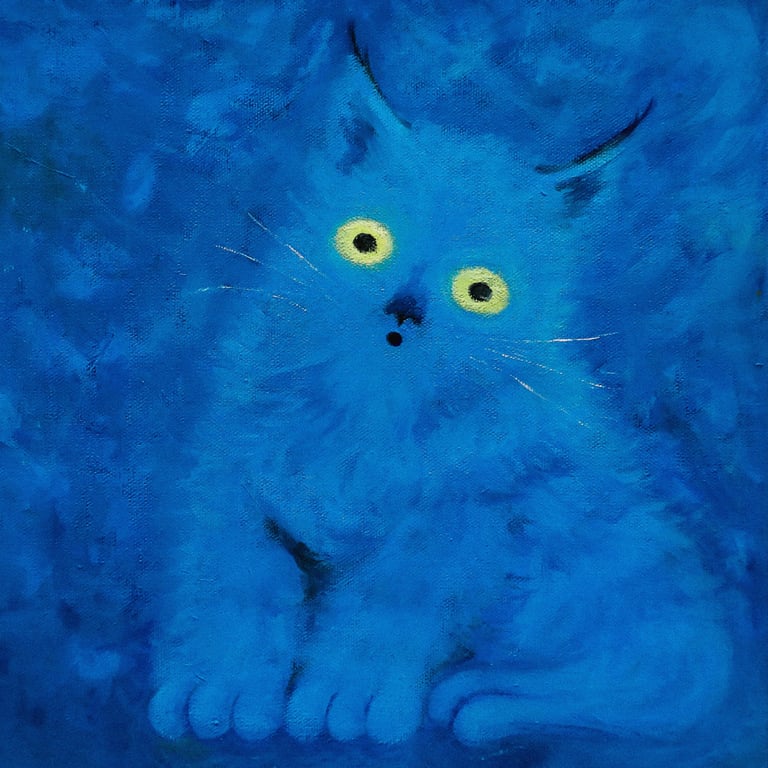
[Ira Dot’s LP In Blue Time is out on digital and vinyl on Feb 27th, 2026 through Second Spring.]

RUNNING MAN PRESS
CoNTACT
info@runningmanpress.ca
© 2024. All rights reserved.
ads@runningmanpress.ca