
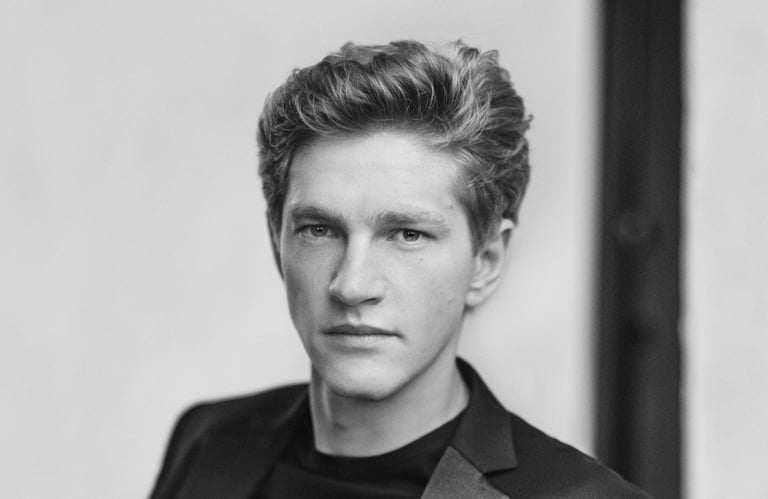
REVIEW: Jan Lisiecki at Centre Pierre-Péladeau
REVIEW
Zonia Jankowska
3/4/20262 min read
The Salle Pierre-Mercure is full of laughter, “long time no see!”, loud hugs and kisses. All of Montreal’s Polonia gathered on the 22/02/2025 in the UQAM’s Centre Pierre-Péladeau for Jan Lisiecki’s piano recital “Cartes Blanches” from the series of “Les Grandes Romantiques”. French, English and Polish merge over the navy seats, foreshadowing the great multicultural experience of the concert.
Lisiecki’s programme was a testimony of his virtuosity, performance maturity, and appreciation of folklore. The title of the concert might be misleading, taking into consideration that composers like Szymanowski (1882-1937), Martinů (1890-1959), De Falla (1876-1946) or Ginastera (1916-(sic!)1983) took a great leap out of the frames of romantic music in their works. However, the pieces played have been connected with nationalistic tendencies and, obviously, small forms for the piano, specifically dances, neatly tackling the beauty of this period in piano repertoire. Staples of it, such as Chopin’s Grande Valse Brillante, op. 18, his Polonaise in B minor, op. 53 or Brahms’ Waltzes no. 3 and 15 from op. 39, were paired with choices that seemed more personal, like Szymanowski’s Quatre danses polonaises, M60 or Martinù’s Trois danses tchèques, H. 154.
The dance character carried the audience throughout the evening; the expressive, unapologetically energetic scenic movement of Lisiecki was almost as captivating as his music. His foot was tapping, resisting the pedal, his fingers were making gracious pirouettes, and all of his body was fully dedicated to making the piano dance. Where instrumentalists tend to theatrically show off their sensibility and depth of interpretation through a set of moves common for players of their instrument, Lisiecki seemed to break through from this artificial “choreography” of pianists, and instead genuinely focus on delivering the character of the dances. The charismatic, theatrical movements are by now the major characteristics of his scenic presence.
And so the audience danced with him; smiles persisted Bartok’s and Szymanowski’s not-so-romantic harmony usage, and carried through whatever it was – light, swaying waltzes or lively folk dances from all around the world. Lisiecki captured both the beauty of his audience and the city in which he was performing. Between the folk music of Spain, Romania, Czechia, Argentina, Germany and Poland, a tribute to Montreal’s diversity and openness can be noticed. Even the most well-known pieces, such as Piazzolla’s Libertango, have been freshly interpreted with Lisiecki’s playfulness and narrative investment. His playing was so energetic that I dare to say that some of the pieces he played – among which Martinù’s notable Troi dances... – gained almost a vitalistic interpretation. No passages were run through, no folk melody was missed in the blistering tempo of some pieces, no conversation between his hands or polyphonic voices was omitted. Everything was played by heart, which is becoming rare these days.
The final measurement of a concert’s success is the audience’s reaction after the last note of the final piece is played. Despite the high average age of the audience, the full Salle Pierre-Mercury stood up before the artist did to give him a standing ovation. Lisiecki came back to the stage, giving an encore twice – admirably staying in the dance convention, once with Paderewski’s Minuet, and the second time with Chopin’s Minute Waltz. Mr. Lisiecki, chapeau bas, gratulacje, enhorabuena!


RUNNING MAN PRESS
CoNTACT
info@runningmanpress.ca
© 2024. All rights reserved.
ads@runningmanpress.ca